[Kaggle]:使用Kaggle服务器训练YOLOv5模型 (白嫖服务器)

【核知坊】:释放青春想象,码动全新视野。
我们希望使用精简的信息传达知识的骨架,启发创造者开启创造之路!!!
内容摘要:最近需要使用 YOLOv5 框架训练一个识别模型,数据集有5000多张图片,直接在3000笔记本CPU上跑,怕是要几天。于是付费使用 OpenBayes 的云服务器,但云服务器使用价格较贵,配置重复。对小众需求者不太友好,于是我去 Kaggle 尝试了白嫖服务器,并成功训练了自己的模型。
关键词:YOLOv5 Kaggle 模型训练
其他相关文章:
⛏。。。
高性能云服务器OpenBayes
花钱去OpenBayes开云计算服务器进行模型训练,花钱训练的就是快,大内存可以直接配置 batch-size 批次 32 或者 64。头疼的的每次启动都要配置一下环境,下载一些依赖包(关闭会被清除,不清楚原因),正式开始使用之前都要花费10分钟时间。用了几天,花了我50块大洋后,心疼不已,于是去Kaggle看看能不能免费训练。
OpenBayes对新用户优惠力度很大,注册赠送 240 分钟 RTX 4090 使用时长+ 300 分钟高性能 CPU 使用时长。直接点击前往:signup - OpenBayes
Kaggle
Kaggle 是一个全球领先的数据科学和机器学习平台,由 Anthony Goldbloom 和 Ben Hamner 于 2010 年创立,并于 2017 年被 Google 收购,现为 Google LLC 的子公司。Kaggle 提供了一个在线社区,汇聚了来自世界各地的数据科学家和机器学习工程师,致力于通过竞赛、数据集分享和代码协作推动人工智能的发展。
🎁 Kaggle 每周福利:免费 GPU 使用
✅ 每周 30 小时免费 GPU 资源
Kaggle 为每位用户每周提供 30 小时 的免费 GPU 使用时间。这些 GPU 资源可用于在 Kaggle 的 Jupyter Notebook 环境中运行和训练模型。
💻 支持的 GPU 类型
Kaggle 提供的 GPU 类型包括:
-
NVIDIA Tesla P100:16GB 显存,适合大多数深度学习任务。
-
NVIDIA T4:15GB 显存,支持混合精度计算,适用于推理和训练任务。
用户可以在 Notebook 设置中选择所需的 GPU 类型。
⏱️ 使用限制
-
单次运行时间:每次 Notebook 会话最长可运行 12 小时,超过时间将被强制中断。
-
每周总时长:每位用户每周最多可使用 30 小时 的 GPU 资源。
🌟 Kaggle 的核心功能
1. 竞赛(Competitions)
Kaggle 的竞赛平台允许企业和研究机构发布实际问题和数据集,吸引全球的数据科学家参与解决。参赛者需在规定时间内提交模型,平台根据预设的评估指标(如准确率、AUC 等)进行排名。优胜者不仅可获得奖金,还可能获得与赞助企业合作的机会,甚至直接受聘于这些公司。PyTorch Tutorial
2.数据集(Datasets)
Kaggle 提供了丰富的开放数据集,涵盖自然语言处理、计算机视觉、金融分析等多个领域。用户可以浏览、下载这些数据集,用于学习、研究或项目开发。kaggle-china.com
3.代码共享(Code / Notebooks)
Kaggle 提供基于云的 Jupyter Notebook 环境,称为 Kernels,用户可以在其中编写、运行和分享代码,进行数据分析和模型训练。这促进了社区成员之间的协作与学习。kaggle-china.com
4.学习资源(Kaggle Learn)
Kaggle Learn 提供了一系列免费的微课程,涵盖 Python 编程、数据可视化、机器学习、深度学习等主题,帮助用户系统地提升技能。
数据集上传
数据集准备:
按照YOLO要求的格式,把数据集整理好后打包为 data.zip 压缩包: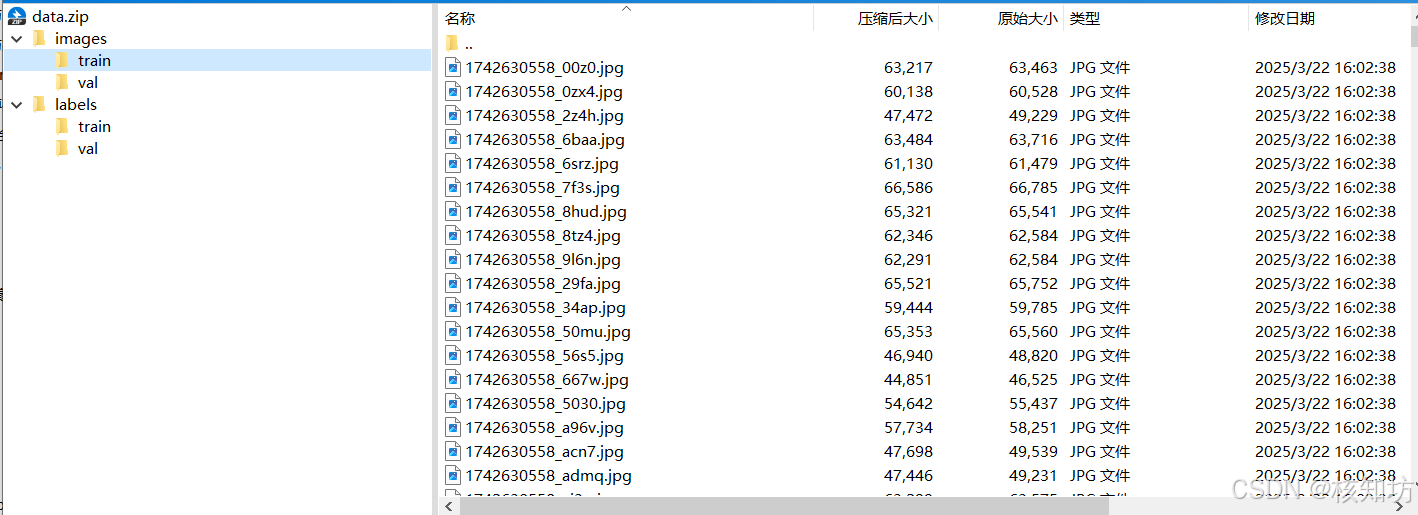
登录或注册Kaggle后点击左侧导航栏 You Work :

点击 Create,选择 New Dataset:

点击 New Dataset:

右侧会出现上传界面,点击上传 data.zip 压缩包,该过程看你的数据大小,需要耐心等待。输入数据集名称,可以追加上传更多文件。最后点击右下角 Create 完成数据集创建。
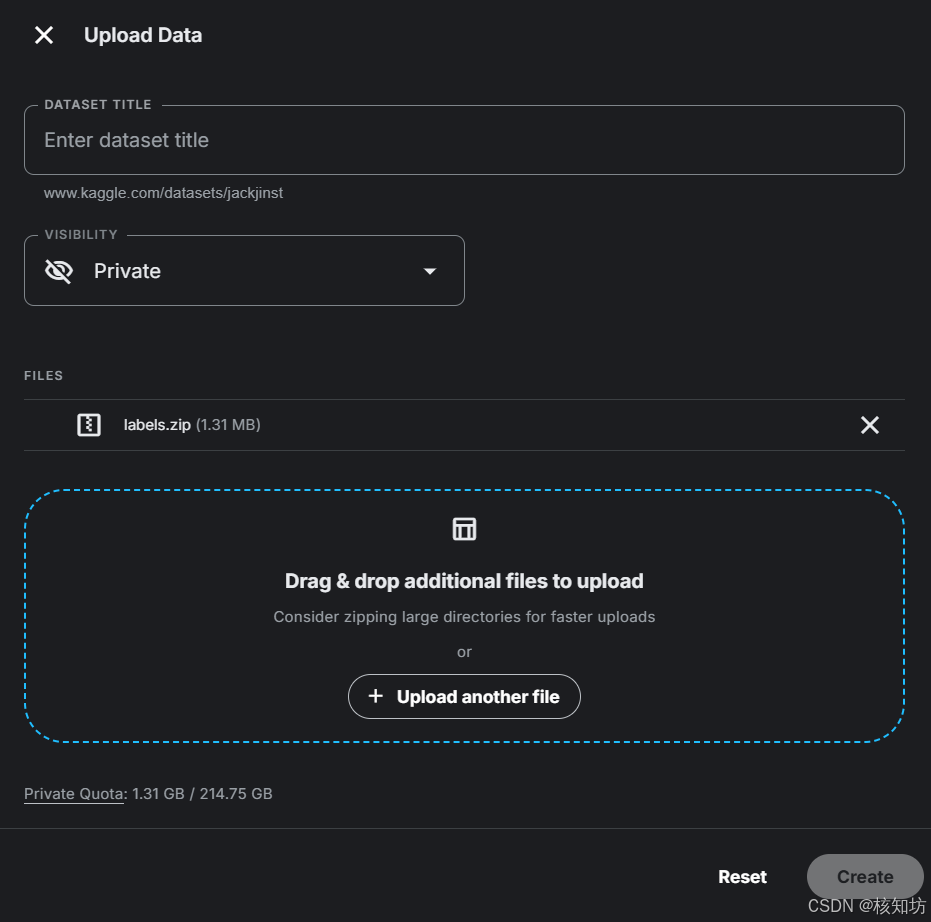
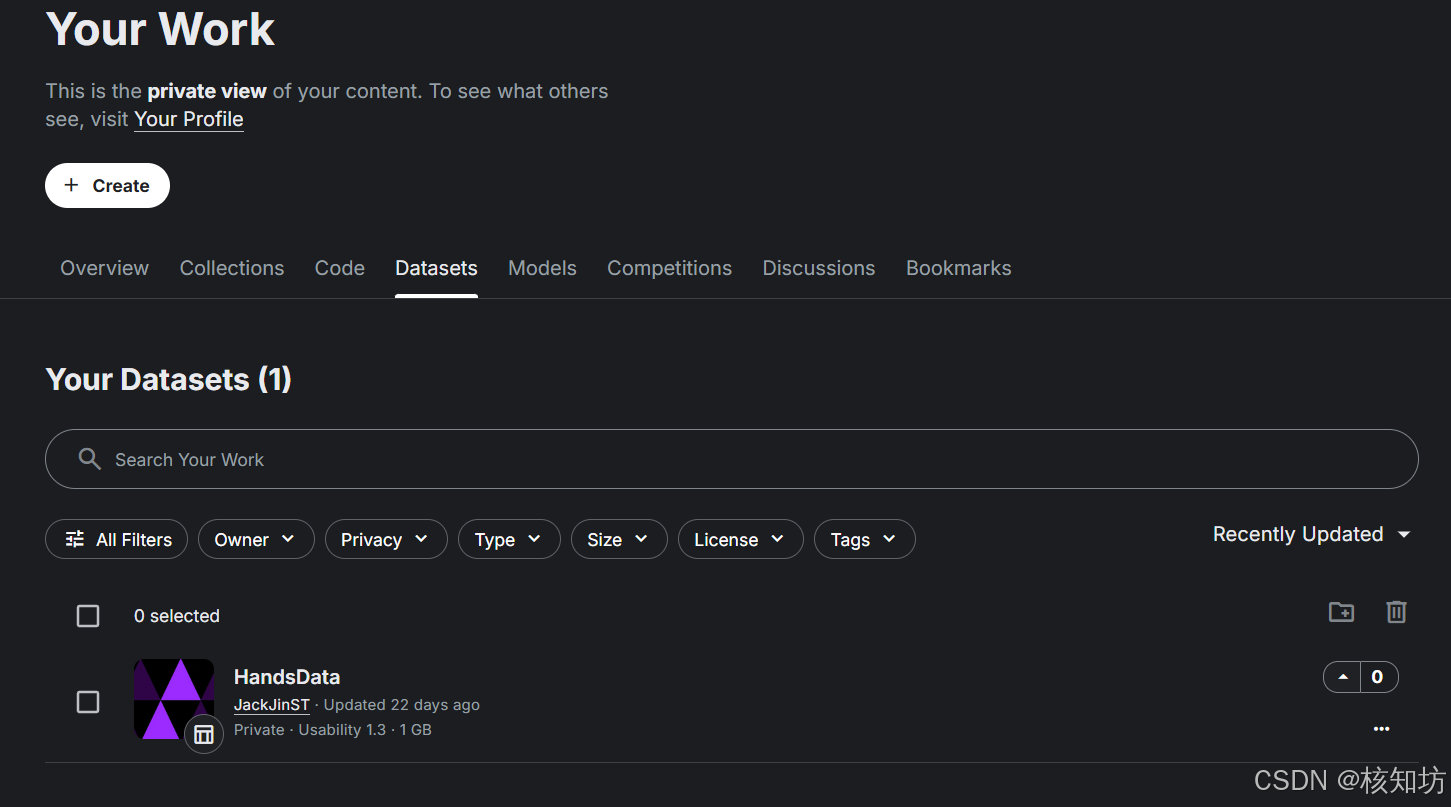
创建成功后你可以在左侧导航栏的 You Work 内的 DataSets 看到所有你的数据集。
创建编辑器(NoteBook)
点击 Create,选择 New Notebook:
绑定数据集
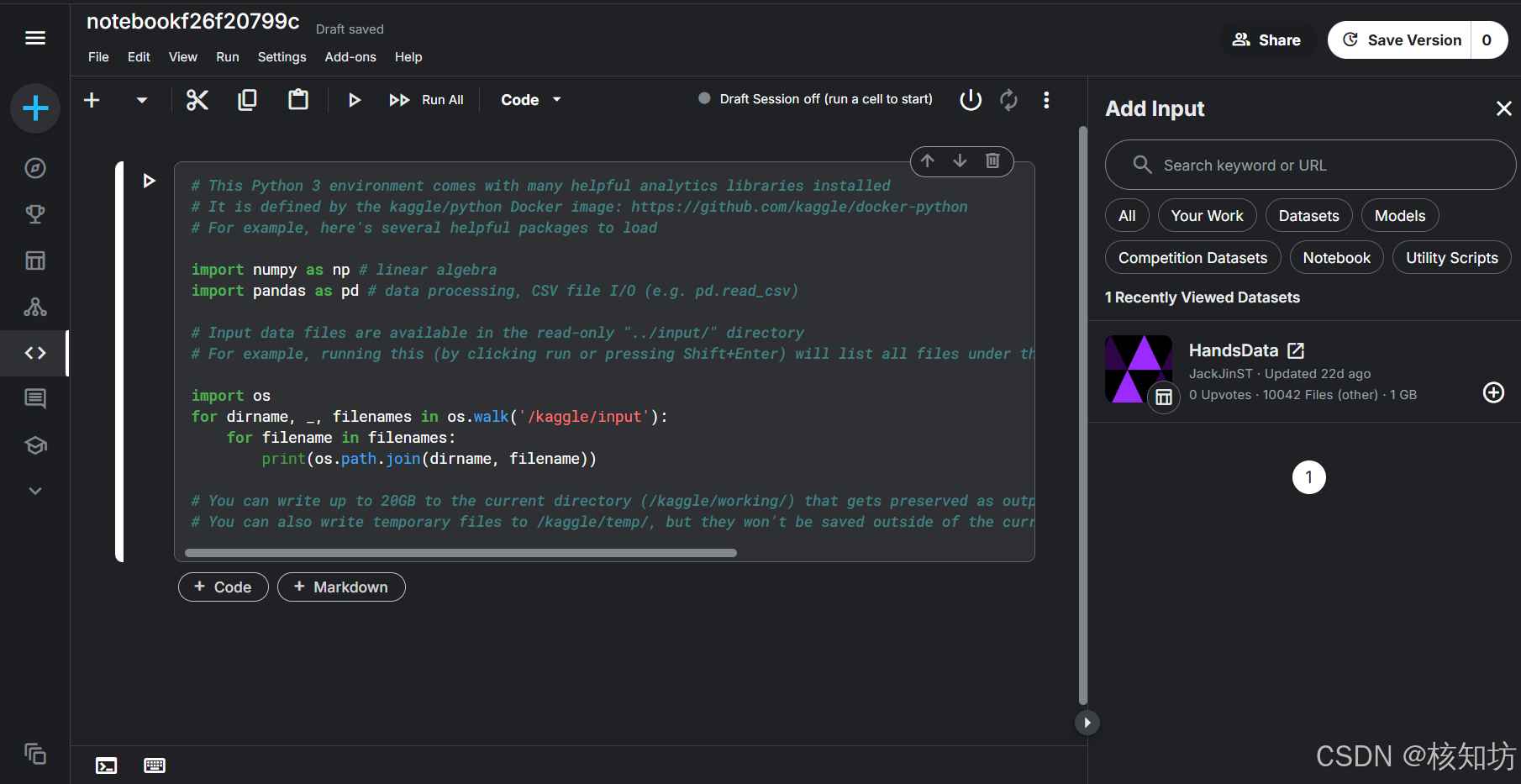
进入界面后,点击右侧 +Add Input 按钮预览数据集,如果你预览过自己刚上传的数据库,就可以直接看到它,没有请去预览一下。
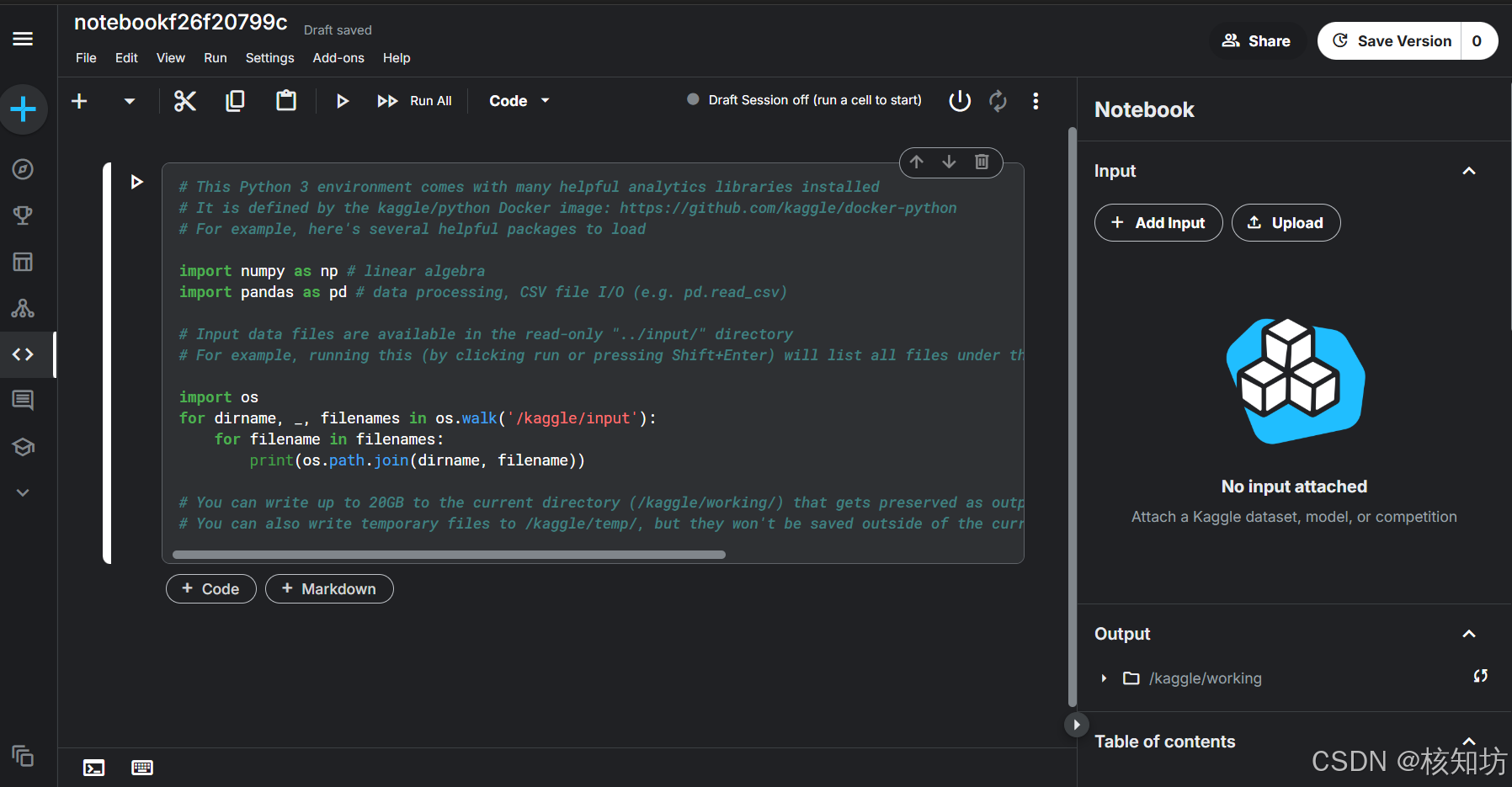
然后点击你的数据库选项右下角的 ➕ 号:
配置YOLOv5框架
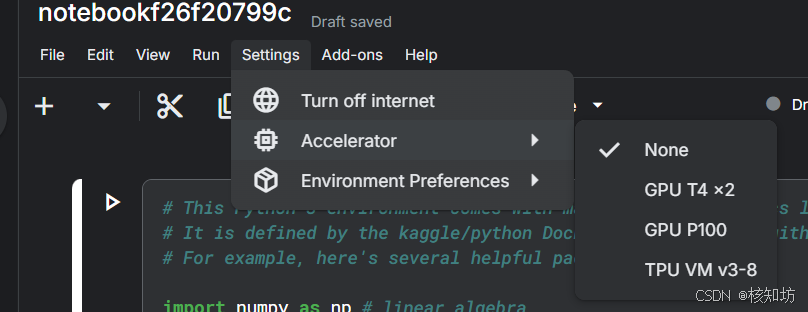
现在开始,直接使用编辑器开始运行代码,服务器型号可以在 Settings->Accelerator 选择:
第一次运行代码时系统自动启动服务器
语法规则(英文):
-
shell 命令: 使用感叹号“!” 作为前缀,直接可以在编辑器中运行。
-
python 代码:直接写
拉取YOLOv5框架源码,等待下载完成:
!git clone https://github.com/ultralytics/yolov5完成后,你可以在右侧状态栏看到文件夹目录:
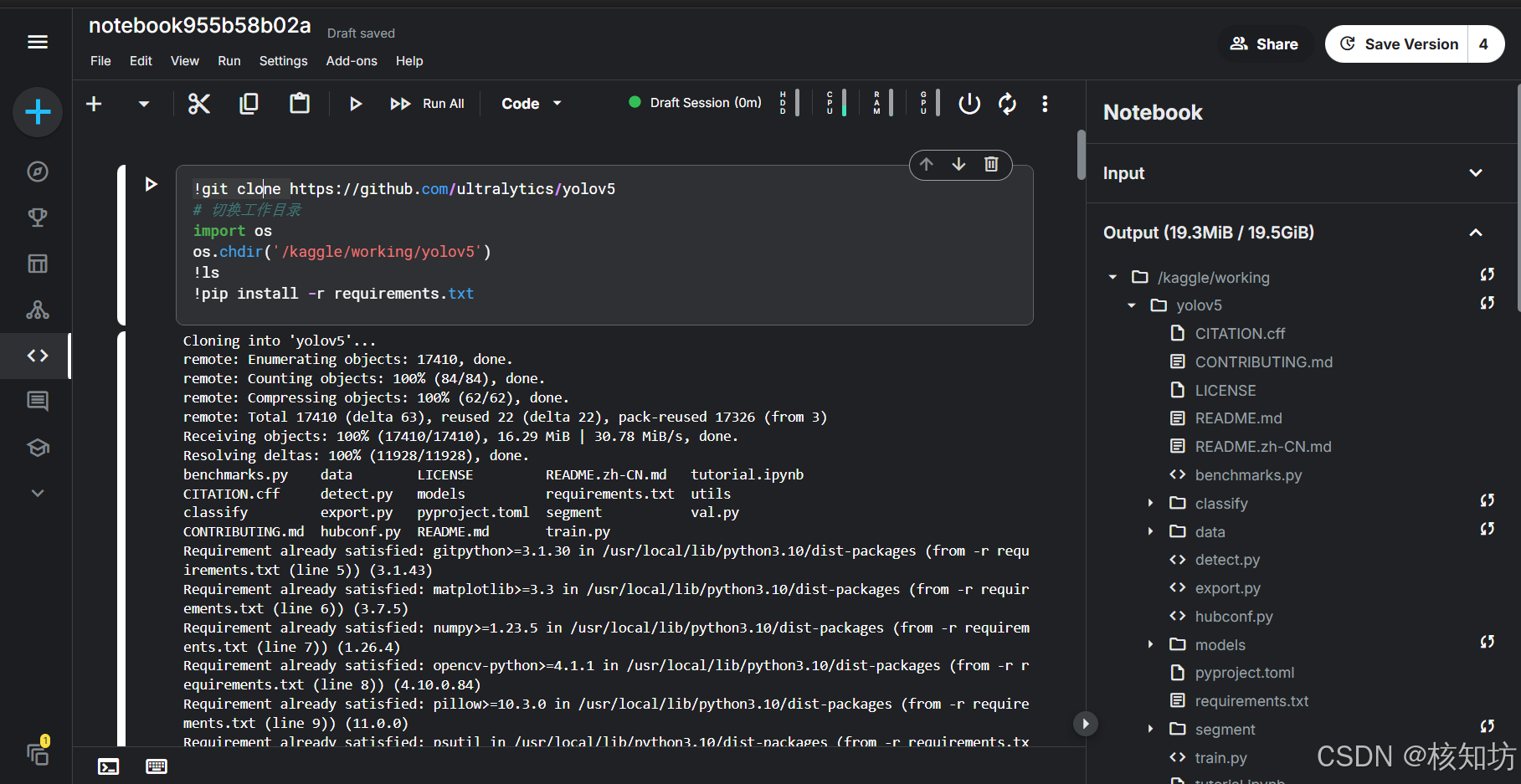
切换目录,进入yolov5框架,安装依赖:
# 切换工作目录
import os
os.chdir('/kaggle/working/yolov5')
!ls
!pip install -r requirements.txt现在,可以为所欲为了!!!但是Kaggel的编辑器不能在线编辑框架里的源码,所以我们直接使用整个文件内容替换命令:第一行 (%%writefile + 文件路径 ), 第一行下的所有内容会覆盖原始文件内容。我建议,自己在笔记本上修改,改好后直接复制粘贴。注意路径前缀 /kaggle/working/
配置数据集
%%writefile /kaggle/working/yolov5/data/coco128.yaml
path: /kaggle/input/handsdata
%%writefile /kaggle/working/yolov5/data/coco128.yaml
# 修改coco128
path: /kaggle/input/handsdata
train: images/train
val: images/val
nc: 1
names: ['Hand']
修改超参数文件(进阶,可选)
%%writefile /kaggle/working/yolov5/data/hyps/hyp.scratch-low.yaml
# 修改超参数文件
lr0: 0.01 # initial learning rate (SGD=1E-2, Adam=1E-3)
lrf: 0.01 # final OneCycleLR learning rate (lr0 * lrf)
momentum: 0.937 # SGD momentum/Adam beta1
weight_decay: 0.0005 # optimizer weight decay 5e-4
warmup_epochs: 3.0 # warmup epochs (fractions ok)
warmup_momentum: 0.8 # warmup initial momentum
warmup_bias_lr: 0.1 # warmup initial bias lr
box: 0.05 # box loss gain
cls: 0.5 # cls loss gain
cls_pw: 1.0 # cls BCELoss positive_weight
obj: 1.0 # obj loss gain (scale with pixels)
obj_pw: 1.0 # obj BCELoss positive_weight
iou_t: 0.20 # IoU training threshold
anchor_t: 4.0 # anchor-multiple threshold
# anchors: 3  # anchors per output layer (0 to ignore)
fl_gamma: 0.0 # focal loss gamma (efficientDet default gamma=1.5)
hsv_h: 0.015 # image HSV-Hue augmentation (fraction)
hsv_s: 0.7 # image HSV-Saturation augmentation (fraction)
hsv_v: 0.4 # image HSV-Value augmentation (fraction)
degrees: 0.0 # image rotation (+/- deg)
translate: 0.1 # image translation (+/- fraction)
scale: 0.5 # image scale (+/- gain)
shear: 0.0 # image shear (+/- deg)
perspective: 0.0 # image perspective (+/- fraction), range 0-0.001
flipud: 0.0 # image flip up-down (probability)
fliplr: 0.5 # image flip left-right (probability)
mosaic: 1.0 # image mosaic (probability)
mixup: 0.0 # image mixup (probability)
copy_paste: 0.0 # segment copy-paste (probability)
修改模型结构文件(进阶,可选)
%%writefile /kaggle/working/yolov5/models/yolov5n.yaml
# YOLOv5 🚀 by Ultralytics, GPL-3.0 license
# Parameters
nc: 1  # number of classes
depth_multiple: 0.33  # model depth multiple
width_multiple: 0.25  # layer channel multiple
anchors:
  - [10,13, 16,30, 33,23]  # P3/8
  - [30,61, 62,45, 59,119]  # P4/16
  - [116,90, 156,198, 373,326]  # P5/32
activation: nn.SiLU()
# YOLOv5 v6.0 backbone
backbone:
  # [from, number, module, args]
  [[-1, 1, Conv, [64, 6, 2, 2]],  # 0-P1/2
   [-1, 1, Conv, [128, 3, 2]],  # 1-P2/4
   [-1, 1, C3, [128, 1]],  # 2
   [-1, 1, Conv, [256, 3, 2]],  # 3-P3/8
   [-1, 1, C3, [256, 1]],  # 4
   [-1, 1, Conv, [512, 3, 2]],  # 5-P4/16
   [-1, 1, C3, [512, 1]],  # 6
   [-1, 1, Conv, [1024, 3, 2]],  # 7-P5/32
   [-1, 1, C3, [1024, 1]],  # 8
   [-1, 1, SPPF, [1024, 5]],  # 9
  ]

# YOLOv5 v6.0 head
head:
  [[-1, 1, Conv, [512, 1, 1]],
   [-1, 1, nn.Upsample, [None, 2, 'nearest']],
   [[-1, 6], 1, Concat, [1]],  # cat backbone P4
   [-1, 1, C3, [512, 1]],  # 13

   [-1, 1, Conv, [256, 1, 1]],
   [-1, 1, nn.Upsample, [None, 2, 'nearest']],
   [[-1, 4], 1, Concat, [1]],  # cat backbone P3
   [-1, 1, C3, [256, 1]],  # 17 (P3/8-small)

   [-1, 1, Conv, [256, 3, 2]],
   [[-1, 13], 1, Concat, [1]],  # cat head P4
   [-1, 1, C3, [512, 1]],  # 20 (P4/16-medium)

   [-1, 1, Conv, [512, 3, 2]],
   [[-1, 9], 1, Concat, [1]],  # cat head P5
   [-1, 1, C3, [1024, 1]],  # 23 (P5/32-large)

   [[17, 20, 23], 1, Detect, [nc, anchors]],  # Detect(P3, P4, P5)
  ]
配置模块输入参数(进阶,可选)
%%writefile /kaggle/working/yolov5/models/common.py
# 修改 common.py
# Ultralytics 🚀 AGPL-3.0 License - https://ultralytics.com/license
"""Common modules."""
import ast
import contextlib
import json
import math
import platform
import warnings
import zipfile
from collections import OrderedDict, namedtuple
from copy import copy
from pathlib import Path
from urllib.parse import urlparse
import cv2
import numpy as np
import pandas as pd
import requests
import torch
import torch.nn as nn
from PIL import Image
from torch.cuda import amp
# Import 'ultralytics' package or install if missing
try:
import ultralytics
assert hasattr(ultralytics, "__version__") # verify package is not directory
except (ImportError, AssertionError):
import os
os.system("pip install -U ultralytics")
import ultralytics
from ultralytics.utils.plotting import Annotator, colors, save_one_box
from utils import TryExcept
from utils.dataloaders import exif_transpose, letterbox
from utils.general import (
LOGGER,
ROOT,
Profile,
check_requirements,
check_suffix,
check_version,
colorstr,
increment_path,
is_jupyter,
make_divisible,
non_max_suppression,
scale_boxes,
xywh2xyxy,
xyxy2xywh,
yaml_load,
)
from utils.torch_utils import copy_attr, smart_inference_mode
def autopad(k, p=None, d=1):
"""
Pads kernel to 'same' output shape, adjusting for optional dilation; returns padding size.
`k`: kernel, `p`: padding, `d`: dilation.
"""
if d > 1:
k = d * (k - 1) + 1 if isinstance(k, int) else [d * (x - 1) + 1 for x in k] # actual kernel-size
if p is None:
p = k // 2 if isinstance(k, int) else [x // 2 for x in k] # auto-pad
return p
class Conv(nn.Module):
"""Applies a convolution, batch normalization, and activation function to an input tensor in a neural network."""
default_act = nn.ReLU6() # default activation
def __init__(self, c1, c2, k=1, s=1, p=None, g=1, d=1, act=True):
"""Initializes a standard convolution layer with optional batch normalization and activation."""
super().__init__()
self.conv = nn.Conv2d(c1, c2, k, s, autopad(k, p, d), groups=g, dilation=d, bias=False)
self.bn = nn.BatchNorm2d(c2)
self.act = self.default_act if act is True else act if isinstance(act, nn.Module) else nn.Identity()
def forward(self, x):
"""Applies a convolution followed by batch normalization and an activation function to the input tensor `x`."""
return self.act(self.bn(self.conv(x)))
def forward_fuse(self, x):
"""Applies a fused convolution and activation function to the input tensor `x`."""
return self.act(self.conv(x))
class DWConv(Conv):
"""Implements a depth-wise convolution layer with optional activation for efficient spatial filtering."""
def __init__(self, c1, c2, k=1, s=1, d=1, act=True):
"""Initializes a depth-wise convolution layer with optional activation; args: input channels (c1), output
channels (c2), kernel size (k), stride (s), dilation (d), and activation flag (act).
"""
super().__init__(c1, c2, k, s, g=math.gcd(c1, c2), d=d, act=act)
class DWConvTranspose2d(nn.ConvTranspose2d):
"""A depth-wise transpose convolutional layer for upsampling in neural networks, particularly in YOLOv5 models."""
def __init__(self, c1, c2, k=1, s=1, p1=0, p2=0):
"""Initializes a depth-wise transpose convolutional layer for YOLOv5; args: input channels (c1), output channels
(c2), kernel size (k), stride (s), input padding (p1), output padding (p2).
"""
super().__init__(c1, c2, k, s, p1, p2, groups=math.gcd(c1, c2))
class TransformerLayer(nn.Module):
"""Transformer layer with multihead attention and linear layers, optimized by removing LayerNorm."""
def __init__(self, c, num_heads):
"""
Initializes a transformer layer, sans LayerNorm for performance, with multihead attention and linear layers.
See as described in https://arxiv.org/abs/2010.11929.
"""
super().__init__()
self.q = nn.Linear(c, c, bias=False)
self.k = nn.Linear(c, c, bias=False)
self.v = nn.Linear(c, c, bias=False)
self.ma = nn.MultiheadAttention(embed_dim=c, num_heads=num_heads)
self.fc1 = nn.Linear(c, c, bias=False)
self.fc2 = nn.Linear(c, c, bias=False)
def forward(self, x):
"""Performs forward pass using MultiheadAttention and two linear transformations with residual connections."""
x = self.ma(self.q(x), self.k(x), self.v(x))[0] + x
x = self.fc2(self.fc1(x)) + x
return x
class TransformerBlock(nn.Module):
"""A Transformer block for vision tasks with convolution, position embeddings, and Transformer layers."""
def __init__(self, c1, c2, num_heads, num_layers):
"""Initializes a Transformer block for vision tasks, adapting dimensions if necessary and stacking specified
layers.
"""
super().__init__()
self.conv = None
if c1 != c2:
self.conv = Conv(c1, c2)
self.linear = nn.Linear(c2, c2) # learnable position embedding
self.tr = nn.Sequential(*(TransformerLayer(c2, num_heads) for _ in range(num_layers)))
self.c2 = c2
def forward(self, x):
"""Processes input through an optional convolution, followed by Transformer layers and position embeddings for
object detection.
"""
if self.conv is not None:
x = self.conv(x)
b, _, w, h = x.shape
p = x.flatten(2).permute(2, 0, 1)
return self.tr(p + self.linear(p)).permute(1, 2, 0).reshape(b, self.c2, w, h)
class Bottleneck(nn.Module):
"""A bottleneck layer with optional shortcut and group convolution for efficient feature extraction."""
def __init__(self, c1, c2, shortcut=True, g=1, e=0.5):
"""Initializes a standard bottleneck layer with optional shortcut and group convolution, supporting channel
expansion.
"""
super().__init__()
c_ = int(c2 * e) # hidden channels
self.cv1 = Conv(c1, c_, 1, 1)
self.cv2 = Conv(c_, c2, 3, 1, g=g)
self.add = shortcut and c1 == c2
def forward(self, x):
"""Processes input through two convolutions, optionally adds shortcut if channel dimensions match; input is a
tensor.
"""
return x + self.cv2(self.cv1(x)) if self.add else self.cv2(self.cv1(x))
class BottleneckCSP(nn.Module):
"""CSP bottleneck layer for feature extraction with cross-stage partial connections and optional shortcuts."""
def __init__(self, c1, c2, n=1, shortcut=True, g=1, e=0.5):
"""Initializes CSP bottleneck with optional shortcuts; args: ch_in, ch_out, number of repeats, shortcut bool,
groups, expansion.
"""
super().__init__()
c_ = int(c2 * e) # hidden channels
self.cv1 = Conv(c1, c_, 1, 1)
self.cv2 = nn.Conv2d(c1, c_, 1, 1, bias=False)
self.cv3 = nn.Conv2d(c_, c_, 1, 1, bias=False)
self.cv4 = Conv(2 * c_, c2, 1, 1)
self.bn = nn.BatchNorm2d(2 * c_) # applied to cat(cv2, cv3)
self.act = nn.SiLU()
self.m = nn.Sequential(*(Bottleneck(c_, c_, shortcut, g, e=1.0) for _ in range(n)))
def forward(self, x):
"""Performs forward pass by applying layers, activation, and concatenation on input x, returning feature-
enhanced output.
"""
y1 = self.cv3(self.m(self.cv1(x)))
y2 = self.cv2(x)
return self.cv4(self.act(self.bn(torch.cat((y1, y2), 1))))
class CrossConv(nn.Module):
"""Implements a cross convolution layer with downsampling, expansion, and optional shortcut."""
def __init__(self, c1, c2, k=3, s=1, g=1, e=1.0, shortcut=False):
"""
Initializes CrossConv with downsampling, expanding, and optionally shortcutting; `c1` input, `c2` output
channels.
Inputs are ch_in, ch_out, kernel, stride, groups, expansion, shortcut.
"""
super().__init__()
c_ = int(c2 * e) # hidden channels
self.cv1 = Conv(c1, c_, (1, k), (1, s))
self.cv2 = Conv(c_, c2, (k, 1), (s, 1), g=g)
self.add = shortcut and c1 == c2
def forward(self, x):
"""Performs feature sampling, expanding, and applies shortcut if channels match; expects `x` input tensor."""
return x + self.cv2(self.cv1(x)) if self.add else self.cv2(self.cv1(x))
class C3(nn.Module):
"""Implements a CSP Bottleneck module with three convolutions for enhanced feature extraction in neural networks."""
def __init__(self, c1, c2, n=1, shortcut=True, g=1, e=0.5):
"""Initializes C3 module with options for channel count, bottleneck repetition, shortcut usage, group
convolutions, and expansion.
"""
super().__init__()
c_ = int(c2 * e) # hidden channels
self.cv1 = Conv(c1, c_, 1, 1)
self.cv2 = Conv(c1, c_, 1, 1)
self.cv3 = Conv(2 * c_, c2, 1) # optional act=FReLU(c2)
self.m = nn.Sequential(*(Bottleneck(c_, c_, shortcut, g, e=1.0) for _ in range(n)))
def forward(self, x):
"""Performs forward propagation using concatenated outputs from two convolutions and a Bottleneck sequence."""
return self.cv3(torch.cat((self.m(self.cv1(x)), self.cv2(x)), 1))
class C3x(C3):
"""Extends the C3 module with cross-convolutions for enhanced feature extraction in neural networks."""
def __init__(self, c1, c2, n=1, shortcut=True, g=1, e=0.5):
"""Initializes C3x module with cross-convolutions, extending C3 with customizable channel dimensions, groups,
and expansion.
"""
super().__init__(c1, c2, n, shortcut, g, e)
c_ = int(c2 * e)
self.m = nn.Sequential(*(CrossConv(c_, c_, 3, 1, g, 1.0, shortcut) for _ in range(n)))
class C3TR(C3):
"""C3 module with TransformerBlock for enhanced feature extraction in object detection models."""
def __init__(self, c1, c2, n=1, shortcut=True, g=1, e=0.5):
"""Initializes C3 module with TransformerBlock for enhanced feature extraction, accepts channel sizes, shortcut
config, group, and expansion.
"""
super().__init__(c1, c2, n, shortcut, g, e)
c_ = int(c2 * e)
self.m = TransformerBlock(c_, c_, 4, n)
class C3SPP(C3):
"""Extends the C3 module with an SPP layer for enhanced spatial feature extraction and customizable channels."""
def __init__(self, c1, c2, k=(5, 9, 13), n=1, shortcut=True, g=1, e=0.5):
"""Initializes a C3 module with SPP layer for advanced spatial feature extraction, given channel sizes, kernel
sizes, shortcut, group, and expansion ratio.
"""
super().__init__(c1, c2, n, shortcut, g, e)
c_ = int(c2 * e)
self.m = SPP(c_, c_, k)
class C3Ghost(C3):
"""Implements a C3 module with Ghost Bottlenecks for efficient feature extraction in YOLOv5."""
def __init__(self, c1, c2, n=1, shortcut=True, g=1, e=0.5):
"""Initializes YOLOv5's C3 module with Ghost Bottlenecks for efficient feature extraction."""
super().__init__(c1, c2, n, shortcut, g, e)
c_ = int(c2 * e) # hidden channels
self.m = nn.Sequential(*(GhostBottleneck(c_, c_) for _ in range(n)))
class SPP(nn.Module):
"""Implements Spatial Pyramid Pooling (SPP) for feature extraction, ref: https://arxiv.org/abs/1406.4729."""
def __init__(self, c1, c2, k=(5, 9, 13)):
"""Initializes SPP layer with Spatial Pyramid Pooling, ref: https://arxiv.org/abs/1406.4729, args: c1 (input channels), c2 (output channels), k (kernel sizes)."""
super().__init__()
c_ = c1 // 2 # hidden channels
self.cv1 = Conv(c1, c_, 1, 1)
self.cv2 = Conv(c_ * (len(k) + 1), c2, 1, 1)
self.m = nn.ModuleList([nn.MaxPool2d(kernel_size=x, stride=1, padding=x // 2) for x in k])
def forward(self, x):
"""Applies convolution and max pooling layers to the input tensor `x`, concatenates results, and returns output
tensor.
"""
x = self.cv1(x)
with warnings.catch_warnings():
warnings.simplefilter("ignore") # suppress torch 1.9.0 max_pool2d() warning
return self.cv2(torch.cat([x] + [m(x) for m in self.m], 1))
class SPPF(nn.Module):
"""Implements a fast Spatial Pyramid Pooling (SPPF) layer for efficient feature extraction in YOLOv5 models."""
def __init__(self, c1, c2, k=5):
"""
Initializes YOLOv5 SPPF layer with given channels and kernel size for YOLOv5 model, combining convolution and
max pooling.
Equivalent to SPP(k=(5, 9, 13)).
"""
super().__init__()
c_ = c1 // 2 # hidden channels
self.cv1 = Conv(c1, c_, 1, 1)
self.cv2 = Conv(c_ * 4, c2, 1, 1)
self.m = nn.MaxPool2d(kernel_size=k, stride=1, padding=k // 2)
def forward(self, x):
"""Processes input through a series of convolutions and max pooling operations for feature extraction."""
x = self.cv1(x)
with warnings.catch_warnings():
warnings.simplefilter("ignore") # suppress torch 1.9.0 max_pool2d() warning
y1 = self.m(x)
y2 = self.m(y1)
return self.cv2(torch.cat((x, y1, y2, self.m(y2)), 1))
class Focus(nn.Module):
"""Focuses spatial information into channel space using slicing and convolution for efficient feature extraction."""
def __init__(self, c1, c2, k=1, s=1, p=None, g=1, act=True):
"""Initializes Focus module to concentrate width-height info into channel space with configurable convolution
parameters.
"""
super().__init__()
self.conv = Conv(c1 * 4, c2, k, s, p, g, act=act)
# self.contract = Contract(gain=2)
def forward(self, x):
"""Processes input through Focus mechanism, reshaping (b,c,w,h) to (b,4c,w/2,h/2) then applies convolution."""
return self.conv(torch.cat((x[..., ::2, ::2], x[..., 1::2, ::2], x[..., ::2, 1::2], x[..., 1::2, 1::2]), 1))
# return self.conv(self.contract(x))
class GhostConv(nn.Module):
"""Implements Ghost Convolution for efficient feature extraction, see https://github.com/huawei-noah/ghostnet."""
def __init__(self, c1, c2, k=1, s=1, g=1, act=True):
"""Initializes GhostConv with in/out channels, kernel size, stride, groups, and activation; halves out channels
for efficiency.
"""
super().__init__()
c_ = c2 // 2 # hidden channels
self.cv1 = Conv(c1, c_, k, s, None, g, act=act)
self.cv2 = Conv(c_, c_, 5, 1, None, c_, act=act)
def forward(self, x):
"""Performs forward pass, concatenating outputs of two convolutions on input `x`: shape (B,C,H,W)."""
y = self.cv1(x)
return torch.cat((y, self.cv2(y)), 1)
class GhostBottleneck(nn.Module):
"""Efficient bottleneck layer using Ghost Convolutions, see https://github.com/huawei-noah/ghostnet."""
def __init__(self, c1, c2, k=3, s=1):
"""Initializes GhostBottleneck with ch_in `c1`, ch_out `c2`, kernel size `k`, stride `s`; see https://github.com/huawei-noah/ghostnet."""
super().__init__()
c_ = c2 // 2
self.conv = nn.Sequential(
GhostConv(c1, c_, 1, 1), # pw
DWConv(c_, c_, k, s, act=False) if s == 2 else nn.Identity(), # dw
GhostConv(c_, c2, 1, 1, act=False),
) # pw-linear
self.shortcut = (
nn.Sequential(DWConv(c1, c1, k, s, act=False), Conv(c1, c2, 1, 1, act=False)) if s == 2 else nn.Identity()
)
def forward(self, x):
"""Processes input through conv and shortcut layers, returning their summed output."""
return self.conv(x) + self.shortcut(x)
class Contract(nn.Module):
"""Contracts spatial dimensions into channel dimensions for efficient processing in neural networks."""
def __init__(self, gain=2):
"""Initializes a layer to contract spatial dimensions (width-height) into channels, e.g., input shape
(1,64,80,80) to (1,256,40,40).
"""
super().__init__()
self.gain = gain
def forward(self, x):
"""Processes input tensor to expand channel dimensions by contracting spatial dimensions, yielding output shape
`(b, c*s*s, h//s, w//s)`.
"""
b, c, h, w = x.size() # assert (h / s == 0) and (W / s == 0), 'Indivisible gain'
s = self.gain
x = x.view(b, c, h // s, s, w // s, s) # x(1,64,40,2,40,2)
x = x.permute(0, 3, 5, 1, 2, 4).contiguous() # x(1,2,2,64,40,40)
return x.view(b, c * s * s, h // s, w // s) # x(1,256,40,40)
class Expand(nn.Module):
"""Expands spatial dimensions by redistributing channels, e.g., from (1,64,80,80) to (1,16,160,160)."""
def __init__(self, gain=2):
"""
Initializes the Expand module to increase spatial dimensions by redistributing channels, with an optional gain
factor.
Example: x(1,64,80,80) to x(1,16,160,160).
"""
super().__init__()
self.gain = gain
def forward(self, x):
"""Processes input tensor x to expand spatial dimensions by redistributing channels, requiring C / gain^2 ==
0.
"""
b, c, h, w = x.size() # assert C / s ** 2 == 0, 'Indivisible gain'
s = self.gain
x = x.view(b, s, s, c // s**2, h, w) # x(1,2,2,16,80,80)
x = x.permute(0, 3, 4, 1, 5, 2).contiguous() # x(1,16,80,2,80,2)
return x.view(b, c // s**2, h * s, w * s) # x(1,16,160,160)
class Concat(nn.Module):
"""Concatenates tensors along a specified dimension for efficient tensor manipulation in neural networks."""
def __init__(self, dimension=1):
"""Initializes a Concat module to concatenate tensors along a specified dimension."""
super().__init__()
self.d = dimension
def forward(self, x):
"""Concatenates a list of tensors along a specified dimension; `x` is a list of tensors, `dimension` is an
int.
"""
return torch.cat(x, self.d)
class DetectMultiBackend(nn.Module):
"""YOLOv5 MultiBackend class for inference on various backends including PyTorch, ONNX, TensorRT, and more."""
def __init__(self, weights="yolov5s.pt", device=torch.device("cpu"), dnn=False, data=None, fp16=False, fuse=True):
"""Initializes DetectMultiBackend with support for various inference backends, including PyTorch and ONNX."""
# PyTorch: weights = *.pt
# TorchScript: *.torchscript
# ONNX Runtime: *.onnx
# ONNX OpenCV DNN: *.onnx --dnn
# OpenVINO: *_openvino_model
# CoreML: *.mlpackage
# TensorRT: *.engine
# TensorFlow SavedModel: *_saved_model
# TensorFlow GraphDef: *.pb
# TensorFlow Lite: *.tflite
# TensorFlow Edge TPU: *_edgetpu.tflite
# PaddlePaddle: *_paddle_model
from models.experimental import attempt_download, attempt_load # scoped to avoid circular import
super().__init__()
w = str(weights[0] if isinstance(weights, list) else weights)
pt, jit, onnx, xml, engine, coreml, saved_model, pb, tflite, edgetpu, tfjs, paddle, triton = self._model_type(w)
fp16 &= pt or jit or onnx or engine or triton # FP16
nhwc = coreml or saved_model or pb or tflite or edgetpu # BHWC formats (vs torch BCWH)
stride = 32 # default stride
cuda = torch.cuda.is_available() and device.type != "cpu" # use CUDA
if not (pt or triton):
w = attempt_download(w) # download if not local
if pt: # PyTorch
model = attempt_load(weights if isinstance(weights, list) else w, device=device, inplace=True, fuse=fuse)
stride = max(int(model.stride.max()), 32) # model stride
names = model.module.names if hasattr(model, "module") else model.names # get class names
model.half() if fp16 else model.float()
self.model = model # explicitly assign for to(), cpu(), cuda(), half()
elif jit: # TorchScript
LOGGER.info(f"Loading {w} for TorchScript inference...")
extra_files = {"config.txt": ""} # model metadata
model = torch.jit.load(w, _extra_files=extra_files, map_location=device)
model.half() if fp16 else model.float()
if extra_files["config.txt"]: # load metadata dict
d = json.loads(
extra_files["config.txt"],
object_hook=lambda d: {int(k) if k.isdigit() else k: v for k, v in d.items()},
)
stride, names = int(d["stride"]), d["names"]
elif dnn: # ONNX OpenCV DNN
LOGGER.info(f"Loading {w} for ONNX OpenCV DNN inference...")
check_requirements("opencv-python>=4.5.4")
net = cv2.dnn.readNetFromONNX(w)
elif onnx: # ONNX Runtime
LOGGER.info(f"Loading {w} for ONNX Runtime inference...")
check_requirements(("onnx", "onnxruntime-gpu" if cuda else "onnxruntime"))
import onnxruntime
providers = ["CUDAExecutionProvider", "CPUExecutionProvider"] if cuda else ["CPUExecutionProvider"]
session = onnxruntime.InferenceSession(w, providers=providers)
output_names = [x.name for x in session.get_outputs()]
meta = session.get_modelmeta().custom_metadata_map # metadata
if "stride" in meta:
stride, names = int(meta["stride"]), eval(meta["names"])
elif xml: # OpenVINO
LOGGER.info(f"Loading {w} for OpenVINO inference...")
check_requirements("openvino>=2023.0") # requires openvino-dev: https://pypi.org/project/openvino-dev/
from openvino.runtime import Core, Layout, get_batch
core = Core()
if not Path(w).is_file(): # if not *.xml
w = next(Path(w).glob("*.xml")) # get *.xml file from *_openvino_model dir
ov_model = core.read_model(model=w, weights=Path(w).with_suffix(".bin"))
if ov_model.get_parameters()[0].get_layout().empty:
ov_model.get_parameters()[0].set_layout(Layout("NCHW"))
batch_dim = get_batch(ov_model)
if batch_dim.is_static:
batch_size = batch_dim.get_length()
ov_compiled_model = core.compile_model(ov_model, device_name="AUTO") # AUTO selects best available device
stride, names = self._load_metadata(Path(w).with_suffix(".yaml")) # load metadata
elif engine: # TensorRT
LOGGER.info(f"Loading {w} for TensorRT inference...")
import tensorrt as trt # https://developer.nvidia.com/nvidia-tensorrt-download
check_version(trt.__version__, "7.0.0", hard=True) # require tensorrt>=7.0.0
if device.type == "cpu":
device = torch.device("cuda:0")
Binding = namedtuple("Binding", ("name", "dtype", "shape", "data", "ptr"))
logger = trt.Logger(trt.Logger.INFO)
with open(w, "rb") as f, trt.Runtime(logger) as runtime:
model = runtime.deserialize_cuda_engine(f.read())
context = model.create_execution_context()
bindings = OrderedDict()
output_names = []
fp16 = False # default updated below
dynamic = False
is_trt10 = not hasattr(model, "num_bindings")
num = range(model.num_io_tensors) if is_trt10 else range(model.num_bindings)
for i in num:
if is_trt10:
name = model.get_tensor_name(i)
dtype = trt.nptype(model.get_tensor_dtype(name))
is_input = model.get_tensor_mode(name) == trt.TensorIOMode.INPUT
if is_input:
if -1 in tuple(model.get_tensor_shape(name)): # dynamic
dynamic = True
context.set_input_shape(name, tuple(model.get_profile_shape(name, 0)[2]))
if dtype == np.float16:
fp16 = True
else: # output
output_names.append(name)
shape = tuple(context.get_tensor_shape(name))
else:
name = model.get_binding_name(i)
dtype = trt.nptype(model.get_binding_dtype(i))
if model.binding_is_input(i):
if -1 in tuple(model.get_binding_shape(i)): # dynamic
dynamic = True
context.set_binding_shape(i, tuple(model.get_profile_shape(0, i)[2]))
if dtype == np.float16:
fp16 = True
else: # output
output_names.append(name)
shape = tuple(context.get_binding_shape(i))
im = torch.from_numpy(np.empty(shape, dtype=dtype)).to(device)
bindings[name] = Binding(name, dtype, shape, im, int(im.data_ptr()))
binding_addrs = OrderedDict((n, d.ptr) for n, d in bindings.items())
batch_size = bindings["images"].shape[0] # if dynamic, this is instead max batch size
elif coreml: # CoreML
LOGGER.info(f"Loading {w} for CoreML inference...")
import coremltools as ct
model = ct.models.MLModel(w)
elif saved_model: # TF SavedModel
LOGGER.info(f"Loading {w} for TensorFlow SavedModel inference...")
import tensorflow as tf
keras = False # assume TF1 saved_model
model = tf.keras.models.load_model(w) if keras else tf.saved_model.load(w)
elif pb: # GraphDef https://www.tensorflow.org/guide/migrate#a_graphpb_or_graphpbtxt
LOGGER.info(f"Loading {w} for TensorFlow GraphDef inference...")
import tensorflow as tf
def wrap_frozen_graph(gd, inputs, outputs):
"""Wraps a TensorFlow GraphDef for inference, returning a pruned function."""
x = tf.compat.v1.wrap_function(lambda: tf.compat.v1.import_graph_def(gd, name=""), []) # wrapped
ge = x.graph.as_graph_element
return x.prune(tf.nest.map_structure(ge, inputs), tf.nest.map_structure(ge, outputs))
def gd_outputs(gd):
"""Generates a sorted list of graph outputs excluding NoOp nodes and inputs, formatted as ':0'."""
name_list, input_list = [], []
for node in gd.node: # tensorflow.core.framework.node_def_pb2.NodeDef
name_list.append(node.name)
input_list.extend(node.input)
return sorted(f"{x}:0" for x in list(set(name_list) - set(input_list)) if not x.startswith("NoOp"))
gd = tf.Graph().as_graph_def() # TF GraphDef
with open(w, "rb") as f:
gd.ParseFromString(f.read())
frozen_func = wrap_frozen_graph(gd, inputs="x:0", outputs=gd_outputs(gd))
elif tflite or edgetpu: # https://www.tensorflow.org/lite/guide/python#install_tensorflow_lite_for_python
try: # https://coral.ai/docs/edgetpu/tflite-python/#update-existing-tf-lite-code-for-the-edge-tpu
from tflite_runtime.interpreter import Interpreter, load_delegate
except ImportError:
import tensorflow as tf
Interpreter, load_delegate = (
tf.lite.Interpreter,
tf.lite.experimental.load_delegate,
)
if edgetpu: # TF Edge TPU https://coral.ai/software/#edgetpu-runtime
LOGGER.info(f"Loading {w} for TensorFlow Lite Edge TPU inference...")
delegate = {"Linux": "libedgetpu.so.1", "Darwin": "libedgetpu.1.dylib", "Windows": "edgetpu.dll"}[
platform.system()
]
interpreter = Interpreter(model_path=w, experimental_delegates=[load_delegate(delegate)])
else: # TFLite
LOGGER.info(f"Loading {w} for TensorFlow Lite inference...")
interpreter = Interpreter(model_path=w) # load TFLite model
interpreter.allocate_tensors() # allocate
input_details = interpreter.get_input_details() # inputs
output_details = interpreter.get_output_details() # outputs
# load metadata
with contextlib.suppress(zipfile.BadZipFile):
with zipfile.ZipFile(w, "r") as model:
meta_file = model.namelist()[0]
meta = ast.literal_eval(model.read(meta_file).decode("utf-8"))
stride, names = int(meta["stride"]), meta["names"]
elif tfjs: # TF.js
raise NotImplementedError("ERROR: YOLOv5 TF.js inference is not supported")
elif paddle: # PaddlePaddle
LOGGER.info(f"Loading {w} for PaddlePaddle inference...")
check_requirements("paddlepaddle-gpu" if cuda else "paddlepaddle")
import paddle.inference as pdi
if not Path(w).is_file(): # if not *.pdmodel
w = next(Path(w).rglob("*.pdmodel")) # get *.pdmodel file from *_paddle_model dir
weights = Path(w).with_suffix(".pdiparams")
config = pdi.Config(str(w), str(weights))
if cuda:
config.enable_use_gpu(memory_pool_init_size_mb=2048, device_id=0)
predictor = pdi.create_predictor(config)
input_handle = predictor.get_input_handle(predictor.get_input_names()[0])
output_names = predictor.get_output_names()
elif triton: # NVIDIA Triton Inference Server
LOGGER.info(f"Using {w} as Triton Inference Server...")
check_requirements("tritonclient[all]")
from utils.triton import TritonRemoteModel
model = TritonRemoteModel(url=w)
nhwc = model.runtime.startswith("tensorflow")
else:
raise NotImplementedError(f"ERROR: {w} is not a supported format")
# class names
if "names" not in locals():
names = yaml_load(data)["names"] if data else {i: f"class{i}" for i in range(999)}
if names[0] == "n01440764" and len(names) == 1000: # ImageNet
names = yaml_load(ROOT / "data/ImageNet.yaml")["names"] # human-readable names
self.__dict__.update(locals()) # assign all variables to self
def forward(self, im, augment=False, visualize=False):
"""Performs YOLOv5 inference on input images with options for augmentation and visualization."""
b, ch, h, w = im.shape # batch, channel, height, width
if self.fp16 and im.dtype != torch.float16:
im = im.half() # to FP16
if self.nhwc:
im = im.permute(0, 2, 3, 1) # torch BCHW to numpy BHWC shape(1,320,192,3)
if self.pt: # PyTorch
y = self.model(im, augment=augment, visualize=visualize) if augment or visualize else self.model(im)
elif self.jit: # TorchScript
y = self.model(im)
elif self.dnn: # ONNX OpenCV DNN
im = im.cpu().numpy() # torch to numpy
self.net.setInput(im)
y = self.net.forward()
elif self.onnx: # ONNX Runtime
im = im.cpu().numpy() # torch to numpy
y = self.session.run(self.output_names, {self.session.get_inputs()[0].name: im})
elif self.xml: # OpenVINO
im = im.cpu().numpy() # FP32
y = list(self.ov_compiled_model(im).values())
elif self.engine: # TensorRT
if self.dynamic and im.shape != self.bindings["images"].shape:
i = self.model.get_binding_index("images")
self.context.set_binding_shape(i, im.shape) # reshape if dynamic
self.bindings["images"] = self.bindings["images"]._replace(shape=im.shape)
for name in self.output_names:
i = self.model.get_binding_index(name)
self.bindings[name].data.resize_(tuple(self.context.get_binding_shape(i)))
s = self.bindings["images"].shape
assert im.shape == s, f"input size {im.shape} {'>' if self.dynamic else 'not equal to'} max model size {s}"
self.binding_addrs["images"] = int(im.data_ptr())
self.context.execute_v2(list(self.binding_addrs.values()))
y = [self.bindings[x].data for x in sorted(self.output_names)]
elif self.coreml: # CoreML
im = im.cpu().numpy()
im = Image.fromarray((im[0] * 255).astype("uint8"))
# im = im.resize((192, 320), Image.BILINEAR)
y = self.model.predict({"image": im}) # coordinates are xywh normalized
if "confidence" in y:
box = xywh2xyxy(y["coordinates"] * [[w, h, w, h]]) # xyxy pixels
conf, cls = y["confidence"].max(1), y["confidence"].argmax(1).astype(np.float)
y = np.concatenate((box, conf.reshape(-1, 1), cls.reshape(-1, 1)), 1)
else:
y = list(reversed(y.values())) # reversed for segmentation models (pred, proto)
elif self.paddle: # PaddlePaddle
im = im.cpu().numpy().astype(np.float32)
self.input_handle.copy_from_cpu(im)
self.predictor.run()
y = [self.predictor.get_output_handle(x).copy_to_cpu() for x in self.output_names]
elif self.triton: # NVIDIA Triton Inference Server
y = self.model(im)
else: # TensorFlow (SavedModel, GraphDef, Lite, Edge TPU)
im = im.cpu().numpy()
if self.saved_model: # SavedModel
y = self.model(im, training=False) if self.keras else self.model(im)
elif self.pb: # GraphDef
y = self.frozen_func(x=self.tf.constant(im))
else: # Lite or Edge TPU
input = self.input_details[0]
int8 = input["dtype"] == np.uint8 # is TFLite quantized uint8 model
if int8:
scale, zero_point = input["quantization"]
im = (im / scale + zero_point).astype(np.uint8) # de-scale
self.interpreter.set_tensor(input["index"], im)
self.interpreter.invoke()
y = []
for output in self.output_details:
x = self.interpreter.get_tensor(output["index"])
if int8:
scale, zero_point = output["quantization"]
x = (x.astype(np.float32) - zero_point) * scale # re-scale
y.append(x)
if len(y) == 2 and len(y[1].shape) != 4:
y = list(reversed(y))
y = [x if isinstance(x, np.ndarray) else x.numpy() for x in y]
y[0][..., :4] *= [w, h, w, h] # xywh normalized to pixels
if isinstance(y, (list, tuple)):
return self.from_numpy(y[0]) if len(y) == 1 else [self.from_numpy(x) for x in y]
else:
return self.from_numpy(y)
def from_numpy(self, x):
"""Converts a NumPy array to a torch tensor, maintaining device compatibility."""
return torch.from_numpy(x).to(self.device) if isinstance(x, np.ndarray) else x
def warmup(self, imgsz=(1, 3, 640, 640)):
"""Performs a single inference warmup to initialize model weights, accepting an `imgsz` tuple for image size."""
warmup_types = self.pt, self.jit, self.onnx, self.engine, self.saved_model, self.pb, self.triton
if any(warmup_types) and (self.device.type != "cpu" or self.triton):
im = torch.empty(*imgsz, dtype=torch.half if self.fp16 else torch.float, device=self.device) # input
for _ in range(2 if self.jit else 1): #
self.forward(im) # warmup
@staticmethod
def _model_type(p="path/to/model.pt"):
"""
Determines model type from file path or URL, supporting various export formats.
Example: path='path/to/model.onnx' -> type=onnx
"""
# types = [pt, jit, onnx, xml, engine, coreml, saved_model, pb, tflite, edgetpu, tfjs, paddle]
from export import export_formats
from utils.downloads import is_url
sf = list(export_formats().Suffix) # export suffixes
if not is_url(p, check=False):
check_suffix(p, sf) # checks
url = urlparse(p) # if url may be Triton inference server
types = [s in Path(p).name for s in sf]
types[8] &= not types[9] # tflite &= not edgetpu
triton = not any(types) and all([any(s in url.scheme for s in ["http", "grpc"]), url.netloc])
return types + [triton]
@staticmethod
def _load_metadata(f=Path("path/to/meta.yaml")):
"""Loads metadata from a YAML file, returning strides and names if the file exists, otherwise `None`."""
if f.exists():
d = yaml_load(f)
return d["stride"], d["names"] # assign stride, names
return None, None
class AutoShape(nn.Module):
"""AutoShape class for robust YOLOv5 inference with preprocessing, NMS, and support for various input formats."""
conf = 0.25 # NMS confidence threshold
iou = 0.45 # NMS IoU threshold
agnostic = False # NMS class-agnostic
multi_label = False # NMS multiple labels per box
classes = None # (optional list) filter by class, i.e. = [0, 15, 16] for COCO persons, cats and dogs
max_det = 1000 # maximum number of detections per image
amp = False # Automatic Mixed Precision (AMP) inference
def __init__(self, model, verbose=True):
"""Initializes YOLOv5 model for inference, setting up attributes and preparing model for evaluation."""
super().__init__()
if verbose:
LOGGER.info("Adding AutoShape... ")
copy_attr(self, model, include=("yaml", "nc", "hyp", "names", "stride", "abc"), exclude=()) # copy attributes
self.dmb = isinstance(model, DetectMultiBackend) # DetectMultiBackend() instance
self.pt = not self.dmb or model.pt # PyTorch model
self.model = model.eval()
if self.pt:
m = self.model.model.model[-1] if self.dmb else self.model.model[-1] # Detect()
m.inplace = False # Detect.inplace=False for safe multithread inference
m.export = True # do not output loss values
def _apply(self, fn):
"""
Applies to(), cpu(), cuda(), half() etc.
to model tensors excluding parameters or registered buffers.
"""
self = super()._apply(fn)
if self.pt:
m = self.model.model.model[-1] if self.dmb else self.model.model[-1] # Detect()
m.stride = fn(m.stride)
m.grid = list(map(fn, m.grid))
if isinstance(m.anchor_grid, list):
m.anchor_grid = list(map(fn, m.anchor_grid))
return self
@smart_inference_mode()
def forward(self, ims, size=640, augment=False, profile=False):
"""
Performs inference on inputs with optional augment & profiling.
Supports various formats including file, URI, OpenCV, PIL, numpy, torch.
"""
# For size(height=640, width=1280), RGB images example inputs are:
# file: ims = 'data/images/zidane.jpg' # str or PosixPath
# URI: = 'https://ultralytics.com/images/zidane.jpg'
# OpenCV: = cv2.imread('image.jpg')[:,:,::-1] # HWC BGR to RGB x(640,1280,3)
# PIL: = Image.open('image.jpg') or ImageGrab.grab() # HWC x(640,1280,3)
# numpy: = np.zeros((640,1280,3)) # HWC
# torch: = torch.zeros(16,3,320,640) # BCHW (scaled to size=640, 0-1 values)
# multiple: = [Image.open('image1.jpg'), Image.open('image2.jpg'), ...] # list of images
dt = (Profile(), Profile(), Profile())
with dt[0]:
if isinstance(size, int): # expand
size = (size, size)
p = next(self.model.parameters()) if self.pt else torch.empty(1, device=self.model.device) # param
autocast = self.amp and (p.device.type != "cpu") # Automatic Mixed Precision (AMP) inference
if isinstance(ims, torch.Tensor): # torch
with amp.autocast(autocast):
return self.model(ims.to(p.device).type_as(p), augment=augment) # inference
# Pre-process
n, ims = (len(ims), list(ims)) if isinstance(ims, (list, tuple)) else (1, [ims]) # number, list of images
shape0, shape1, files = [], [], [] # image and inference shapes, filenames
for i, im in enumerate(ims):
f = f"image{i}" # filename
if isinstance(im, (str, Path)): # filename or uri
im, f = Image.open(requests.get(im, stream=True).raw if str(im).startswith("http") else im), im
im = np.asarray(exif_transpose(im))
elif isinstance(im, Image.Image): # PIL Image
im, f = np.asarray(exif_transpose(im)), getattr(im, "filename", f) or f
files.append(Path(f).with_suffix(".jpg").name)
if im.shape[0] < 5: # image in CHW
im = im.transpose((1, 2, 0)) # reverse dataloader .transpose(2, 0, 1)
im = im[..., :3] if im.ndim == 3 else cv2.cvtColor(im, cv2.COLOR_GRAY2BGR) # enforce 3ch input
s = im.shape[:2] # HWC
shape0.append(s) # image shape
g = max(size) / max(s) # gain
shape1.append([int(y * g) for y in s])
ims[i] = im if im.data.contiguous else np.ascontiguousarray(im) # update
shape1 = [make_divisible(x, self.stride) for x in np.array(shape1).max(0)] # inf shape
x = [letterbox(im, shape1, auto=False)[0] for im in ims] # pad
x = np.ascontiguousarray(np.array(x).transpose((0, 3, 1, 2))) # stack and BHWC to BCHW
x = torch.from_numpy(x).to(p.device).type_as(p) / 255 # uint8 to fp16/32
with amp.autocast(autocast):
# Inference
with dt[1]:
y = self.model(x, augment=augment) # forward
# Post-process
with dt[2]:
y = non_max_suppression(
y if self.dmb else y[0],
self.conf,
self.iou,
self.classes,
self.agnostic,
self.multi_label,
max_det=self.max_det,
) # NMS
for i in range(n):
scale_boxes(shape1, y[i][:, :4], shape0[i])
return Detections(ims, y, files, dt, self.names, x.shape)
class Detections:
"""Manages YOLOv5 detection results with methods for visualization, saving, cropping, and exporting detections."""
def __init__(self, ims, pred, files, times=(0, 0, 0), names=None, shape=None):
"""Initializes the YOLOv5 Detections class with image info, predictions, filenames, timing and normalization."""
super().__init__()
d = pred[0].device # device
gn = [torch.tensor([*(im.shape[i] for i in [1, 0, 1, 0]), 1, 1], device=d) for im in ims] # normalizations
self.ims = ims # list of images as numpy arrays
self.pred = pred # list of tensors pred[0] = (xyxy, conf, cls)
self.names = names # class names
self.files = files # image filenames
self.times = times # profiling times
self.xyxy = pred # xyxy pixels
self.xywh = [xyxy2xywh(x) for x in pred] # xywh pixels
self.xyxyn = [x / g for x, g in zip(self.xyxy, gn)] # xyxy normalized
self.xywhn = [x / g for x, g in zip(self.xywh, gn)] # xywh normalized
self.n = len(self.pred) # number of images (batch size)
self.t = tuple(x.t / self.n * 1e3 for x in times) # timestamps (ms)
self.s = tuple(shape) # inference BCHW shape
def _run(self, pprint=False, show=False, save=False, crop=False, render=False, labels=True, save_dir=Path("")):
"""Executes model predictions, displaying and/or saving outputs with optional crops and labels."""
s, crops = "", []
for i, (im, pred) in enumerate(zip(self.ims, self.pred)):
s += f"
image {i + 1}/{len(self.pred)}: {im.shape[0]}x{im.shape[1]} " # string
if pred.shape[0]:
for c in pred[:, -1].unique():
n = (pred[:, -1] == c).sum() # detections per class
s += f"{n} {self.names[int(c)]}{'s' * (n > 1)}, " # add to string
s = s.rstrip(", ")
if show or save or render or crop:
annotator = Annotator(im, example=str(self.names))
for *box, conf, cls in reversed(pred): # xyxy, confidence, class
label = f"{self.names[int(cls)]} {conf:.2f}"
if crop:
file = save_dir / "crops" / self.names[int(cls)] / self.files[i] if save else None
crops.append(
{
"box": box,
"conf": conf,
"cls": cls,
"label": label,
"im": save_one_box(box, im, file=file, save=save),
}
)
else: # all others
annotator.box_label(box, label if labels else "", color=colors(cls))
im = annotator.im
else:
s += "(no detections)"
im = Image.fromarray(im.astype(np.uint8)) if isinstance(im, np.ndarray) else im # from np
if show:
if is_jupyter():
from IPython.display import display
display(im)
else:
im.show(self.files[i])
if save:
f = self.files[i]
im.save(save_dir / f) # save
if i == self.n - 1:
LOGGER.info(f"Saved {self.n} image{'s' * (self.n > 1)} to {colorstr('bold', save_dir)}")
if render:
self.ims[i] = np.asarray(im)
if pprint:
s = s.lstrip("
")
return f"{s}
Speed: %.1fms pre-process, %.1fms inference, %.1fms NMS per image at shape {self.s}" % self.t
if crop:
if save:
LOGGER.info(f"Saved results to {save_dir}
")
return crops
@TryExcept("Showing images is not supported in this environment")
def show(self, labels=True):
"""
Displays detection results with optional labels.
Usage: show(labels=True)
"""
self._run(show=True, labels=labels) # show results
def save(self, labels=True, save_dir="runs/detect/exp", exist_ok=False):
"""
Saves detection results with optional labels to a specified directory.
Usage: save(labels=True, save_dir='runs/detect/exp', exist_ok=False)
"""
save_dir = increment_path(save_dir, exist_ok, mkdir=True) # increment save_dir
self._run(save=True, labels=labels, save_dir=save_dir) # save results
def crop(self, save=True, save_dir="runs/detect/exp", exist_ok=False):
"""
Crops detection results, optionally saves them to a directory.
Args: save (bool), save_dir (str), exist_ok (bool).
"""
save_dir = increment_path(save_dir, exist_ok, mkdir=True) if save else None
return self._run(crop=True, save=save, save_dir=save_dir) # crop results
def render(self, labels=True):
"""Renders detection results with optional labels on images; args: labels (bool) indicating label inclusion."""
self._run(render=True, labels=labels) # render results
return self.ims
def pandas(self):
"""
Returns detections as pandas DataFrames for various box formats (xyxy, xyxyn, xywh, xywhn).
Example: print(results.pandas().xyxy[0]).
"""
new = copy(self) # return copy
ca = "xmin", "ymin", "xmax", "ymax", "confidence", "class", "name" # xyxy columns
cb = "xcenter", "ycenter", "width", "height", "confidence", "class", "name" # xywh columns
for k, c in zip(["xyxy", "xyxyn", "xywh", "xywhn"], [ca, ca, cb, cb]):
a = [[x[:5] + [int(x[5]), self.names[int(x[5])]] for x in x.tolist()] for x in getattr(self, k)] # update
setattr(new, k, [pd.DataFrame(x, columns=c) for x in a])
return new
def tolist(self):
"""
Converts a Detections object into a list of individual detection results for iteration.
Example: for result in results.tolist():
"""
r = range(self.n) # iterable
return [
Detections(
[self.ims[i]],
[self.pred[i]],
[self.files[i]],
self.times,
self.names,
self.s,
)
for i in r
]
def print(self):
"""Logs the string representation of the current object's state via the LOGGER."""
LOGGER.info(self.__str__())
def __len__(self):
"""Returns the number of results stored, overrides the default len(results)."""
return self.n
def __str__(self):
"""Returns a string representation of the model's results, suitable for printing, overrides default
print(results).
"""
return self._run(pprint=True) # print results
def __repr__(self):
"""Returns a string representation of the YOLOv5 object, including its class and formatted results."""
return f"YOLOv5 {self.__class__} instance
" + self.__str__()
class Proto(nn.Module):
"""YOLOv5 mask Proto module for segmentation models, performing convolutions and upsampling on input tensors."""
def __init__(self, c1, c_=256, c2=32):
"""Initializes YOLOv5 Proto module for segmentation with input, proto, and mask channels configuration."""
super().__init__()
self.cv1 = Conv(c1, c_, k=3)
self.upsample = nn.Upsample(scale_factor=2, mode="nearest")
self.cv2 = Conv(c_, c_, k=3)
self.cv3 = Conv(c_, c2)
def forward(self, x):
"""Performs a forward pass using convolutional layers and upsampling on input tensor `x`."""
return self.cv3(self.cv2(self.upsample(self.cv1(x))))
class Classify(nn.Module):
"""YOLOv5 classification head with convolution, pooling, and dropout layers for channel transformation."""
def __init__(
self, c1, c2, k=1, s=1, p=None, g=1, dropout_p=0.0
): # ch_in, ch_out, kernel, stride, padding, groups, dropout probability
"""Initializes YOLOv5 classification head with convolution, pooling, and dropout layers for input to output
channel transformation.
"""
super().__init__()
c_ = 1280 # efficientnet_b0 size
self.conv = Conv(c1, c_, k, s, autopad(k, p), g)
self.pool = nn.AdaptiveAvgPool2d(1) # to x(b,c_,1,1)
self.drop = nn.Dropout(p=dropout_p, inplace=True)
self.linear = nn.Linear(c_, c2) # to x(b,c2)
def forward(self, x):
"""Processes input through conv, pool, drop, and linear layers; supports list concatenation input."""
if isinstance(x, list):
x = torch.cat(x, 1)
return self.linear(self.drop(self.pool(self.conv(x)).flatten(1)))
#
class RepConv(nn.Module):
"""
RepConv module with training and deploy modes.
This module is used in RT-DETR and can fuse convolutions during inference for efficiency.
Attributes:
conv1 (Conv): 3x3 convolution.
conv2 (Conv): 1x1 convolution.
bn (nn.BatchNorm2d, optional): Batch normalization for identity branch.
act (nn.Module): Activation function.
default_act (nn.Module): Default activation function (SiLU).
References:
https://github.com/DingXiaoH/RepVGG/blob/main/repvgg.py
"""
default_act = nn.ReLU6() # default activation
# def __init__(self, c1, c2, k=1, s=1, p=None, g=1, d=1, act=True)
def __init__(self, c1, c2, k=3, s=1, p=1, g=1, d=1, act=True, bn=False, deploy=False):
"""
Initialize RepConv module with given parameters.
Args:
c1 (int): Number of input channels.
c2 (int): Number of output channels.
k (int): Kernel size.
s (int): Stride.
p (int): Padding.
g (int): Groups.
d (int): Dilation.
act (bool | nn.Module): Activation function.
bn (bool): Use batch normalization for identity branch.
deploy (bool): Deploy mode for inference.
"""
super().__init__()
assert k == 3 and p == 1
self.g = g
self.c1 = c1
self.c2 = c2
self.act = self.default_act if act is True else act if isinstance(act, nn.Module) else nn.Identity()
self.bn = nn.BatchNorm2d(num_features=c1) if bn and c2 == c1 and s == 1 else None
# def __init__(self, c1, c2, k=1, s=1, p=None, g=1, d=1, act=True)
self.conv1 = Conv(c1, c2, k, s, p=p, g=g, act=False)
self.conv2 = Conv(c1, c2, 1, s, p=(p - k // 2), g=g, act=False)
def forward_fuse(self, x):
"""
Forward pass for deploy mode.
Args:
x (torch.Tensor): Input tensor.
Returns:
(torch.Tensor): Output tensor.
"""
return self.act(self.conv(x))
def forward(self, x):
"""
Forward pass for training mode.
Args:
x (torch.Tensor): Input tensor.
Returns:
(torch.Tensor): Output tensor.
"""
id_out = 0 if self.bn is None else self.bn(x)
return self.act(self.conv1(x) + self.conv2(x) + id_out)
def get_equivalent_kernel_bias(self):
"""
Calculate equivalent kernel and bias by fusing convolutions.
Returns:
(tuple): Tuple containing:
- Equivalent kernel (torch.Tensor)
- Equivalent bias (torch.Tensor)
"""
kernel3x3, bias3x3 = self._fuse_bn_tensor(self.conv1)
kernel1x1, bias1x1 = self._fuse_bn_tensor(self.conv2)
kernelid, biasid = self._fuse_bn_tensor(self.bn)
return kernel3x3 + self._pad_1x1_to_3x3_tensor(kernel1x1) + kernelid, bias3x3 + bias1x1 + biasid
@staticmethod
def _pad_1x1_to_3x3_tensor(kernel1x1):
"""
Pad a 1x1 kernel to 3x3 size.
Args:
kernel1x1 (torch.Tensor): 1x1 convolution kernel.
Returns:
(torch.Tensor): Padded 3x3 kernel.
"""
if kernel1x1 is None:
return 0
else:
return torch.nn.functional.pad(kernel1x1, [1, 1, 1, 1])
def _fuse_bn_tensor(self, branch):
"""
Fuse batch normalization with convolution weights.
Args:
branch (Conv | nn.BatchNorm2d | None): Branch to fuse.
Returns:
(tuple): Tuple containing:
- Fused kernel (torch.Tensor)
- Fused bias (torch.Tensor)
"""
if branch is None:
return 0, 0
if isinstance(branch, Conv):
kernel = branch.conv.weight
running_mean = branch.bn.running_mean
running_var = branch.bn.running_var
gamma = branch.bn.weight
beta = branch.bn.bias
eps = branch.bn.eps
elif isinstance(branch, nn.BatchNorm2d):
if not hasattr(self, "id_tensor"):
input_dim = self.c1 // self.g
kernel_value = np.zeros((self.c1, input_dim, 3, 3), dtype=np.float32)
for i in range(self.c1):
kernel_value[i, i % input_dim, 1, 1] = 1
self.id_tensor = torch.from_numpy(kernel_value).to(branch.weight.device)
kernel = self.id_tensor
running_mean = branch.running_mean
running_var = branch.running_var
gamma = branch.weight
beta = branch.bias
eps = branch.eps
std = (running_var + eps).sqrt()
t = (gamma / std).reshape(-1, 1, 1, 1)
return kernel * t, beta - running_mean * gamma / std
def fuse_convs(self):
"""Fuse convolutions for inference by creating a single equivalent convolution."""
if hasattr(self, "conv"):
return
kernel, bias = self.get_equivalent_kernel_bias()
self.conv = nn.Conv2d(
in_channels=self.c1,
out_channels=self.c2,
kernel_size=self.s,
stride=self.conv1.conv.stride,
padding=self.conv1.conv.padding,
dilation=self.conv1.conv.dilation,
groups=self.conv1.conv.groups,
bias=True,
).requires_grad_(False)
self.conv.weight.data = kernel
self.conv.bias.data = bias
for para in self.parameters():
para.detach_()
self.__delattr__("conv1")
self.__delattr__("conv2")
if hasattr(self, "nm"):
self.__delattr__("nm")
if hasattr(self, "bn"):
self.__delattr__("bn")
if hasattr(self, "id_tensor"):
self.__delattr__("id_tensor")
class ECA(nn.Module):
"""Constructs a ECA module.
Args:
channel: Number of channels of the input feature map
k_size: Adaptive selection of kernel size
"""
def __init__(self, c1, c2, k_size=3):
super(ECA, self).__init__()
self.avg_pool = nn.AdaptiveAvgPool2d(1)
self.conv = nn.Conv1d(1, 1, kernel_size=k_size, padding=(k_size - 1) // 2, bias=False)
self.sigmoid = nn.Sigmoid()
def forward(self, x):
# feature descriptor on the global spatial information
y = self.avg_pool(x)
y = self.conv(y.squeeze(-1).transpose(-1, -2)).transpose(-1, -2).unsqueeze(-1)
# Multi-scale information fusion
y = self.sigmoid(y)
return x * y.expand_as(x) 引入创新模块(进阶,可选)
%%writefile /kaggle/working/yolov5/models/yolo.py
# 修改 yolo.py
# Ultralytics 🚀 AGPL-3.0 License - https://ultralytics.com/license
"""
YOLO-specific modules.

Usage:
    $ python models/yolo.py --cfg yolov5s.yaml
"""

import argparse
import contextlib
import math
import os
import platform
import sys
from copy import deepcopy
from pathlib import Path

import torch
import torch.nn as nn

FILE = Path(__file__).resolve()
ROOT = FILE.parents[1]  # YOLOv5 root directory
if str(ROOT) not in sys.path:
    sys.path.append(str(ROOT))  # add ROOT to PATH
if platform.system() != "Windows":
    ROOT = Path(os.path.relpath(ROOT, Path.cwd()))  # relative
from models.common import (
    ECA,
    C3,
    C3SPP,
    C3TR,
    SPP,
    SPPF,
    Bottleneck,
    BottleneckCSP,
    C3Ghost,
    C3x,
    Classify,
    Concat,
    Contract,
    Conv,
    RepConv,
    CrossConv,
    DetectMultiBackend,
    DWConv,
    DWConvTranspose2d,
    Expand,
    Focus,
    GhostBottleneck,
    GhostConv,
    Proto,
)
from models.experimental import MixConv2d
from utils.autoanchor import check_anchor_order
from utils.general import LOGGER, check_version, check_yaml, colorstr, make_divisible, print_args
from utils.plots import feature_visualization
from utils.torch_utils import (
    fuse_conv_and_bn,
    initialize_weights,
    model_info,
    profile,
    scale_img,
    select_device,
    time_sync,
)

try:
    import thop  # for FLOPs computation
except ImportError:
    thop = None


class Detect(nn.Module):
    """YOLOv5 Detect head for processing input tensors and generating detection outputs in object detection models."""

    stride = None  # strides computed during build
    dynamic = False  # force grid reconstruction
    export = False  # export mode

    def __init__(self, nc=80, anchors=(), ch=(), inplace=True):
        """Initializes YOLOv5 detection layer with specified classes, anchors, channels, and inplace operations."""
        super().__init__()
        self.nc = nc  # number of classes
        self.no = nc + 5  # number of outputs per anchor
        self.nl = len(anchors)  # number of detection layers
        self.na = len(anchors[0]) // 2  # number of anchors
        self.grid = [torch.empty(0) for _ in range(self.nl)]  # init grid
        self.anchor_grid = [torch.empty(0) for _ in range(self.nl)]  # init anchor grid
        self.register_buffer("anchors", torch.tensor(anchors).float().view(self.nl, -1, 2))  # shape(nl,na,2)
        self.m = nn.ModuleList(nn.Conv2d(x, self.no * self.na, 1) for x in ch)  # output conv
        self.inplace = inplace  # use inplace ops (e.g. slice assignment)

    def forward(self, x):
        """Processes input through YOLOv5 layers, altering shape for detection: `x(bs, 3, ny, nx, 85)`."""
        z = []  # inference output
        for i in range(self.nl):
            x[i] = self.m[i](x[i])  # conv
            bs, _, ny, nx = x[i].shape  # x(bs,255,20,20) to x(bs,3,20,20,85)
            x[i] = x[i].view(bs, self.na, self.no, ny, nx).permute(0, 1, 3, 4, 2).contiguous()

            if not self.training:  # inference
                if self.dynamic or self.grid[i].shape[2:4] != x[i].shape[2:4]:
                    self.grid[i], self.anchor_grid[i] = self._make_grid(nx, ny, i)

                if isinstance(self, Segment):  # (boxes + masks)
                    xy, wh, conf, mask = x[i].split((2, 2, self.nc + 1, self.no - self.nc - 5), 4)
                    xy = (xy.sigmoid() * 2 + self.grid[i]) * self.stride[i]  # xy
                    wh = (wh.sigmoid() * 2) ** 2 * self.anchor_grid[i]  # wh
                    y = torch.cat((xy, wh, conf.sigmoid(), mask), 4)
                else:  # Detect (boxes only)
                    xy, wh, conf = x[i].sigmoid().split((2, 2, self.nc + 1), 4)
                    xy = (xy * 2 + self.grid[i]) * self.stride[i]  # xy
                    wh = (wh * 2) ** 2 * self.anchor_grid[i]  # wh
                    y = torch.cat((xy, wh, conf), 4)
                z.append(y.view(bs, self.na * nx * ny, self.no))

        return x if self.training else (torch.cat(z, 1),) if self.export else (torch.cat(z, 1), x)

    def _make_grid(self, nx=20, ny=20, i=0, torch_1_10=check_version(torch.__version__, "1.10.0")):
        """Generates a mesh grid for anchor boxes with optional compatibility for torch versions < 1.10."""
        d = self.anchors[i].device
        t = self.anchors[i].dtype
        shape = 1, self.na, ny, nx, 2  # grid shape
        y, x = torch.arange(ny, device=d, dtype=t), torch.arange(nx, device=d, dtype=t)
        yv, xv = torch.meshgrid(y, x, indexing="ij") if torch_1_10 else torch.meshgrid(y, x)  # torch>=0.7 compatibility
        grid = torch.stack((xv, yv), 2).expand(shape) - 0.5  # add grid offset, i.e. y = 2.0 * x - 0.5
        anchor_grid = (self.anchors[i] * self.stride[i]).view((1, self.na, 1, 1, 2)).expand(shape)
        return grid, anchor_grid


class Segment(Detect):
    """YOLOv5 Segment head for segmentation models, extending Detect with mask and prototype layers."""

    def __init__(self, nc=80, anchors=(), nm=32, npr=256, ch=(), inplace=True):
        """Initializes YOLOv5 Segment head with options for mask count, protos, and channel adjustments."""
        super().__init__(nc, anchors, ch, inplace)
        self.nm = nm  # number of masks
        self.npr = npr  # number of protos
        self.no = 5 + nc + self.nm  # number of outputs per anchor
        self.m = nn.ModuleList(nn.Conv2d(x, self.no * self.na, 1) for x in ch)  # output conv
        self.proto = Proto(ch[0], self.npr, self.nm)  # protos
        self.detect = Detect.forward

    def forward(self, x):
        """Processes input through the network, returning detections and prototypes; adjusts output based on
        training/export mode.
        """
        p = self.proto(x[0])
        x = self.detect(self, x)
        return (x, p) if self.training else (x[0], p) if self.export else (x[0], p, x[1])


class BaseModel(nn.Module):
    """YOLOv5 base model."""

    def forward(self, x, profile=False, visualize=False):
        """Executes a single-scale inference or training pass on the YOLOv5 base model, with options for profiling and
        visualization.
        """
        return self._forward_once(x, profile, visualize)  # single-scale inference, train

    def _forward_once(self, x, profile=False, visualize=False):
        """Performs a forward pass on the YOLOv5 model, enabling profiling and feature visualization options."""
        y, dt = [], []  # outputs
        for m in self.model:
            if m.f != -1:  # if not from previous layer
                x = y[m.f] if isinstance(m.f, int) else [x if j == -1 else y[j] for j in m.f]  # from earlier layers
            if profile:
                self._profile_one_layer(m, x, dt)
            x = m(x)  # run
            y.append(x if m.i in self.save else None)  # save output
            if visualize:
                feature_visualization(x, m.type, m.i, save_dir=visualize)
        return x

    def _profile_one_layer(self, m, x, dt):
        """Profiles a single layer's performance by computing GFLOPs, execution time, and parameters."""
        c = m == self.model[-1]  # is final layer, copy input as inplace fix
        o = thop.profile(m, inputs=(x.copy() if c else x,), verbose=False)[0] / 1e9 * 2 if thop else 0  # FLOPs
        t = time_sync()
        for _ in range(10):
            m(x.copy() if c else x)
        dt.append((time_sync() - t) * 100)
        if m == self.model[0]:
            LOGGER.info(f"{'time (ms)':>10s} {'GFLOPs':>10s} {'params':>10s}  module")
        LOGGER.info(f"{dt[-1]:10.2f} {o:10.2f} {m.np:10.0f}  {m.type}")
        if c:
            LOGGER.info(f"{sum(dt):10.2f} {'-':>10s} {'-':>10s}  Total")

    def fuse(self):
        """Fuses Conv2d() and BatchNorm2d() layers in the model to improve inference speed."""
        LOGGER.info("Fusing layers... ")
        for m in self.model.modules():
            if isinstance(m, (Conv, DWConv)) and hasattr(m, "bn"):
                m.conv = fuse_conv_and_bn(m.conv, m.bn)  # update conv
                delattr(m, "bn")  # remove batchnorm
                m.forward = m.forward_fuse  # update forward
        self.info()
        return self

    def info(self, verbose=False, img_size=640):
        """Prints model information given verbosity and image size, e.g., `info(verbose=True, img_size=640)`."""
        model_info(self, verbose, img_size)

    def _apply(self, fn):
        """Applies transformations like to(), cpu(), cuda(), half() to model tensors excluding parameters or registered
        buffers.
        """
        self = super()._apply(fn)
        m = self.model[-1]  # Detect()
        if isinstance(m, (Detect, Segment)):
            m.stride = fn(m.stride)
            m.grid = list(map(fn, m.grid))
            if isinstance(m.anchor_grid, list):
                m.anchor_grid = list(map(fn, m.anchor_grid))
        return self


class DetectionModel(BaseModel):
    """YOLOv5 detection model class for object detection tasks, supporting custom configurations and anchors."""

    def __init__(self, cfg="yolov5s.yaml", ch=3, nc=None, anchors=None):
        """Initializes YOLOv5 model with configuration file, input channels, number of classes, and custom anchors."""
        super().__init__()
        if isinstance(cfg, dict):
            self.yaml = cfg  # model dict
        else:  # is *.yaml
            import yaml  # for torch hub

            self.yaml_file = Path(cfg).name
            with open(cfg, encoding="ascii", errors="ignore") as f:
                self.yaml = yaml.safe_load(f)  # model dict

        # Define model
        ch = self.yaml["ch"] = self.yaml.get("ch", ch)  # input channels
        if nc and nc != self.yaml["nc"]:
            LOGGER.info(f"Overriding model.yaml nc={self.yaml['nc']} with nc={nc}")
            self.yaml["nc"] = nc  # override yaml value
        if anchors:
            LOGGER.info(f"Overriding model.yaml anchors with anchors={anchors}")
            self.yaml["anchors"] = round(anchors)  # override yaml value
        self.model, self.save = parse_model(deepcopy(self.yaml), ch=[ch])  # model, savelist
        self.names = [str(i) for i in range(self.yaml["nc"])]  # default names
        self.inplace = self.yaml.get("inplace", True)

        # Build strides, anchors
        m = self.model[-1]  # Detect()
        if isinstance(m, (Detect, Segment)):

            def _forward(x):
                """Passes the input 'x' through the model and returns the processed output."""
                return self.forward(x)[0] if isinstance(m, Segment) else self.forward(x)

            s = 256  # 2x min stride
            m.inplace = self.inplace
            m.stride = torch.tensor([s / x.shape[-2] for x in _forward(torch.zeros(1, ch, s, s))])  # forward
            check_anchor_order(m)
            m.anchors /= m.stride.view(-1, 1, 1)
            self.stride = m.stride
            self._initialize_biases()  # only run once

        # Init weights, biases
        initialize_weights(self)
        self.info()
        LOGGER.info("")

    def forward(self, x, augment=False, profile=False, visualize=False):
        """Performs single-scale or augmented inference and may include profiling or visualization."""
        if augment:
            return self._forward_augment(x)  # augmented inference, None
        return self._forward_once(x, profile, visualize)  # single-scale inference, train

    def _forward_augment(self, x):
        """Performs augmented inference across different scales and flips, returning combined detections."""
        img_size = x.shape[-2:]  # height, width
        s = [1, 0.83, 0.67]  # scales
        f = [None, 3, None]  # flips (2-ud, 3-lr)
        y = []  # outputs
        for si, fi in zip(s, f):
            xi = scale_img(x.flip(fi) if fi else x, si, gs=int(self.stride.max()))
            yi = self._forward_once(xi)[0]  # forward
            # cv2.imwrite(f'img_{si}.jpg', 255 * xi[0].cpu().numpy().transpose((1, 2, 0))[:, :, ::-1])  # save
            yi = self._descale_pred(yi, fi, si, img_size)
            y.append(yi)
        y = self._clip_augmented(y)  # clip augmented tails
        return torch.cat(y, 1), None  # augmented inference, train

    def _descale_pred(self, p, flips, scale, img_size):
        """De-scales predictions from augmented inference, adjusting for flips and image size."""
        if self.inplace:
            p[..., :4] /= scale  # de-scale
            if flips == 2:
                p[..., 1] = img_size[0] - p[..., 1]  # de-flip ud
            elif flips == 3:
                p[..., 0] = img_size[1] - p[..., 0]  # de-flip lr
        else:
            x, y, wh = p[..., 0:1] / scale, p[..., 1:2] / scale, p[..., 2:4] / scale  # de-scale
            if flips == 2:
                y = img_size[0] - y  # de-flip ud
            elif flips == 3:
                x = img_size[1] - x  # de-flip lr
            p = torch.cat((x, y, wh, p[..., 4:]), -1)
        return p

    def _clip_augmented(self, y):
        """Clips augmented inference tails for YOLOv5 models, affecting first and last tensors based on grid points and
        layer counts.
        """
        nl = self.model[-1].nl  # number of detection layers (P3-P5)
        g = sum(4**x for x in range(nl))  # grid points
        e = 1  # exclude layer count
        i = (y[0].shape[1] // g) * sum(4**x for x in range(e))  # indices
        y[0] = y[0][:, :-i]  # large
        i = (y[-1].shape[1] // g) * sum(4 ** (nl - 1 - x) for x in range(e))  # indices
        y[-1] = y[-1][:, i:]  # small
        return y

    def _initialize_biases(self, cf=None):
        """
        Initializes biases for YOLOv5's Detect() module, optionally using class frequencies (cf).

        For details see https://arxiv.org/abs/1708.02002 section 3.3.
        """
        # cf = torch.bincount(torch.tensor(np.concatenate(dataset.labels, 0)[:, 0]).long(), minlength=nc) + 1.
        m = self.model[-1]  # Detect() module
        for mi, s in zip(m.m, m.stride):  # from
            b = mi.bias.view(m.na, -1)  # conv.bias(255) to (3,85)
            b.data[:, 4] += math.log(8 / (640 / s) ** 2)  # obj (8 objects per 640 image)
            b.data[:, 5 : 5 + m.nc] += (
                math.log(0.6 / (m.nc - 0.99999)) if cf is None else torch.log(cf / cf.sum())
            )  # cls
            mi.bias = torch.nn.Parameter(b.view(-1), requires_grad=True)


Model = DetectionModel  # retain YOLOv5 'Model' class for backwards compatibility


class SegmentationModel(DetectionModel):
    """YOLOv5 segmentation model for object detection and segmentation tasks with configurable parameters."""

    def __init__(self, cfg="yolov5s-seg.yaml", ch=3, nc=None, anchors=None):
        """Initializes a YOLOv5 segmentation model with configurable params: cfg (str) for configuration, ch (int) for channels, nc (int) for num classes, anchors (list)."""
        super().__init__(cfg, ch, nc, anchors)


class ClassificationModel(BaseModel):
    """YOLOv5 classification model for image classification tasks, initialized with a config file or detection model."""

    def __init__(self, cfg=None, model=None, nc=1000, cutoff=10):
        """Initializes YOLOv5 model with config file `cfg`, input channels `ch`, number of classes `nc`, and `cuttoff`
        index.
        """
        super().__init__()
        self._from_detection_model(model, nc, cutoff) if model is not None else self._from_yaml(cfg)

    def _from_detection_model(self, model, nc=1000, cutoff=10):
        """Creates a classification model from a YOLOv5 detection model, slicing at `cutoff` and adding a classification
        layer.
        """
        if isinstance(model, DetectMultiBackend):
            model = model.model  # unwrap DetectMultiBackend
        model.model = model.model[:cutoff]  # backbone
        m = model.model[-1]  # last layer
        ch = m.conv.in_channels if hasattr(m, "conv") else m.cv1.conv.in_channels  # ch into module
        c = Classify(ch, nc)  # Classify()
        c.i, c.f, c.type = m.i, m.f, "models.common.Classify"  # index, from, type
        model.model[-1] = c  # replace
        self.model = model.model
        self.stride = model.stride
        self.save = []
        self.nc = nc

    def _from_yaml(self, cfg):
        """Creates a YOLOv5 classification model from a specified *.yaml configuration file."""
        self.model = None

# 模型构建
def parse_model(d, ch):
    """Parses a YOLOv5 model from a dict `d`, configuring layers based on input channels `ch` and model architecture."""
    LOGGER.info(f"
{'':>3}{'from':>18}{'n':>3}{'params':>10}  {'module':<40}{'arguments':<30}")
    anchors, nc, gd, gw, act, ch_mul = (
        d["anchors"],
        d["nc"],
        d["depth_multiple"],
        d["width_multiple"],
        d.get("activation"),
        d.get("channel_multiple"),
    )
    # 如果 act 配置项存在,就根据配置修改卷积层的默认激活函数。
    if act:
        Conv.default_act = eval(act)  # redefine default activation, i.e. Conv.default_act = nn.SiLU()
        RepConv.default_act = eval(act)

        LOGGER.info(f"{colorstr('activation:')} {act}")  # print
    if not ch_mul:
        ch_mul = 8
    # 每个锚点的数量,通常为锚点列表中的每对(width, height)
    na = (len(anchors[0]) // 2) if isinstance(anchors, list) else anchors  # number of anchors
    # 每个输出的通道数,计算公式为 锚点数 * (类别数 + 5),5 代表边界框的 4 个坐标加上置信度。
    no = na * (nc + 5)  # number of outputs = anchors * (classes + 5)

    layers, save, c2 = [], [], ch[-1]  # layers, savelist, ch out
    # 解析每一行结构
    for i, (f, n, m, args) in enumerate(d["backbone"] + d["head"]):  # from, number, module, args
        # 动态解析字符串为对应的类
        m = eval(m) if isinstance(m, str) else m  # eval strings
        for j, a in enumerate(args):
            with contextlib.suppress(NameError):
                args[j] = eval(a) if isinstance(a, str) else a  # eval strings
        # 重复数量
        n = n_ = max(round(n * gd), 1) if n > 1 else n  # depth gain
        # 卷积层处理
        if m in {
            Conv,
            RepConv,
            GhostConv,
            Bottleneck,
            GhostBottleneck,
            SPP,
            SPPF,
            DWConv,
            MixConv2d,
            Focus,
            CrossConv,
            BottleneckCSP,
            C3,
            ECA,
            C3TR,
            C3SPP,
            C3Ghost,
            nn.ConvTranspose2d,
            DWConvTranspose2d,
            C3x,
        }:
            c1, c2 = ch[f], args[0]
            if c2 != no:  # if not output
                c2 = make_divisible(c2 * gw, ch_mul)

            args = [c1, c2, *args[1:]]
            if m in {BottleneckCSP, C3, C3TR, C3Ghost, C3x}:
                args.insert(2, n)  # number of repeats
                n = 1
        elif m is nn.BatchNorm2d:
            args = [ch[f]]
        elif m is Concat:
            c2 = sum(ch[x] for x in f)
        # TODO: channel, gw, gd
        elif m in {Detect, Segment}:
            args.append([ch[x] for x in f])
            if isinstance(args[1], int):  # number of anchors
                args[1] = [list(range(args[1] * 2))] * len(f)
            if m is Segment:
                args[3] = make_divisible(args[3] * gw, ch_mul)
        elif m is Contract:
            c2 = ch[f] * args[0] ** 2
        elif m is Expand:
            c2 = ch[f] // args[0] ** 2
        else:
            c2 = ch[f]

        m_ = nn.Sequential(*(m(*args) for _ in range(n))) if n > 1 else m(*args)  # module
        t = str(m)[8:-2].replace("__main__.", "")  # module type
        np = sum(x.numel() for x in m_.parameters())  # number params
        m_.i, m_.f, m_.type, m_.np = i, f, t, np  # attach index, 'from' index, type, number params
        LOGGER.info(f"{i:>3}{str(f):>18}{n_:>3}{np:10.0f}  {t:<40}{str(args):<30}")  # print
        save.extend(x % i for x in ([f] if isinstance(f, int) else f) if x != -1)  # append to savelist
        # 保存结构层
        layers.append(m_)
        if i == 0:
            ch = []
        ch.append(c2)
    return nn.Sequential(*layers), sorted(save)


if __name__ == "__main__":
    parser = argparse.ArgumentParser()
    parser.add_argument("--cfg", type=str, default="yolov5s_custom.yaml", help="model.yaml")
    parser.add_argument("--batch-size", type=int, default=1, help="total batch size for all GPUs")
    parser.add_argument("--device", default="cpu", help="cuda device, i.e. 0 or 0,1,2,3 or cpu")
    parser.add_argument("--profile", action="store_true", help="profile model speed")
    parser.add_argument("--line-profile", action="store_true", help="profile model speed layer by layer")
    parser.add_argument("--test", action="store_true", help="test all yolo*.yaml")
    opt = parser.parse_args()
    opt.cfg = check_yaml(opt.cfg)  # check YAML
    print_args(vars(opt))
    device = select_device(opt.device)

    # Create model
    im = torch.rand(opt.batch_size, 3, 640, 640).to(device)
    model = Model(opt.cfg).to(device)

    # Options
    if opt.line_profile:  # profile layer by layer
        model(im, profile=True)

    elif opt.profile:  # profile forward-backward
        results = profile(input=im, ops=[model], n=3)

    elif opt.test:  # test all models
        for cfg in Path(ROOT / "models").rglob("yolo*.yaml"):
            try:
                _ = Model(cfg)
            except Exception as e:
                print(f"Error in {cfg}: {e}")

    else:  # report fused model summary
        model.fuse()
训练模型
直接训练命令即可开始畅想漫长的等待时刻,现在是抖音时间!!!
!python train.py --data coco128.yaml --cfg yolov5n.yaml --weights '' --epochs 150 --batch-size 64 --img-size 640 --hyp hyp.scratch-low.yaml --device 0 需要下载指定文件夹的,比如训练结果,现在压缩,然后在右侧选中文件,右边点击三个小点进行下载:
没反应的请F12抓取下载链接,直接复制到浏览器搜索栏即可下载。
import os
import zipfile
def zip_folder(source_folder, output_zip):
"""
将指定目录打包为 ZIP 文件。
:param source_folder: 需要压缩的目录路径
:param output_zip: 输出 ZIP 文件的完整路径(包含 .zip)
"""
with zipfile.ZipFile(output_zip, 'w', zipfile.ZIP_DEFLATED) as zipf:
for root, dirs, files in os.walk(source_folder):
for file in files:
file_path = os.path.join(root, file)
arcname = os.path.relpath(file_path, source_folder) # 保持相对路径
zipf.write(file_path, arcname)
print(f"文件夹 '{source_folder}' 已成功压缩至 '{output_zip}'")
if __name__ == "__main__":
source_directory = "./runs/train/exp2" # 需要压缩的文件夹路径
output_zip_path = "./ECA_4_9_150.zip" # 目标 ZIP 文件路径
# 确保输出目录存在
os.makedirs(os.path.dirname(output_zip_path), exist_ok=True)
zip_folder(source_directory, output_zip_path) # 终止训练
# !pkill -9 -f train.py文章总结
本文详细介绍了使用 Kaggel 免费服务器进行YOLOv5模型训练,整个流程同样适用于其他训练框架。本文还提供了YOLOv5改进代码示例。
感谢阅览,如果你喜欢该内容的话,可以点赞,收藏,转发。由于 Koro 能力有限,有任何问题请在评论区内提出,Koro 看到后第一时间回复您!!!
其他精彩内容: